Application: Use of preamplifiers in ultrasonic flaw detection, thickness gaging, and other ultrasonic test and measurement applications.
Theory of Operation: The primary purpose of a preamplifier is to improve receiver signal to noise ratios in applications involving low level acoustic signals. By providing supplementary low noise amplification, a preamp allows use of lower gain in the primary test instrument, thus limiting baseline noise. A preamp may permit detection of small echoes that cannot be detected even at maximum gain in the primary test instrument. Additionally, the RF bandpass filtering in preamplifiers further helps limit high frequency noise. The waveforms below represents a thickness measurement of a 5.6 in. (140 mm) rubber tire tread over fabric reinforcements in a heavy equipment tire, using a special 500 KHz dual element transducer. In the absence of a preamplifier in some challenging tests like this, instrument receiver gain must be set near maximum in order to obtain an echo, and there can be significant baseline noise: ![]()
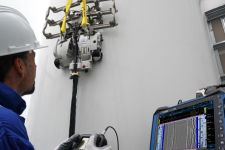

But if a preamplifier is added to the receiver side of the system, then instrument gain can be lowered by more than 30 dB while still maintaining a strong backwall echo, greatly reducing baseline noise:
2. Through transmission, pitch/catch, or dual element transducer systems
General notes: As noted above, whenever using preamplifiers the test instrument should normally be set to through transmission, dual element, or pitch/catch mode even when using single element transducers in a pulse/echo setup. Preamplifiers are most effective in situations where signal loss is due to attenuation rather than scattering from grain boundaries, reinforcing fibers, or other discrete reflectors. This is because scatter noise will be amplified along with the desired echoes. The amount of gain that can be effectively used in any given ultrasonic system is limited by the internal noise levels and amplifier characteristics of the instruments involved. Panametrics-NDT preamplifiers have very low internal noise (5µv peak to peak referred to the input for the 5660B), but generally system RF voltage gains above 100 dB are not practical. Panametrics-NDT flaw detectors and pulser/receivers should be used in the lowest practical gain setting when a preamplifier is used to avoid amplifier saturation. In some cases, a high gain preamplifier output can overload input circuitry of certain ultrasonic instruments, resulting in baseline offset and non-linear amplitude presentations. Careful adjustment of RF filtering and instrument gain can help minimize this effect. In extreme cases an external attenuator can be inserted between the preamplifier output and the instrument receiver input. In high gain systems, it is important to insure that the coaxial integrity of the transducer cables is maintained in order to prevent external RF noise pickup. When operating in pulse/echo mode, the transducer excitation pulse must not exceed 500 volts for the Model 5682, or 300 volts for all other models, to prevent possible preamplifier damage. This restriction does not apply to through transmission or dual element setups. When operating in pulse/echo mode, amplification of the excitation pulse or interface echoes can result in reduced near surface resolution. Careful adjustment of RF filtering and pulser damping can help minimize this effect. When using a preamplifier to compensate for transmission losses in very long cables, the preamp must be located at the transducer end of the cable. |
The 5073PR manually controlled ultrasonic pulser-receiver is for both conventional and high frequency applications. 75 MHz (-3 dB) bandwidth with fast rise time spike pulser extends performance for work with 50 MHz transducers in applications that challenge limits in axial and near surface resolution.
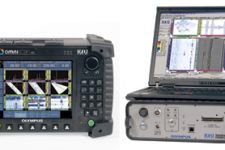
The EPOCH 600 is mid-level, handheld ultrasonic flaw detector. Weighing only 1.68 kg (3.72 lb.), its horizontal case is built to withstand the rigors of very harsh environments. EN12668-1 plus features such as 400 V PerfectSquare tunable square wave pulser, digital filtering for enhanced signal-to-noise ratio.Copyright 2011 OLYMPUS CORPORATION, All rights reserved. Terms Of Use | Privacy Statement