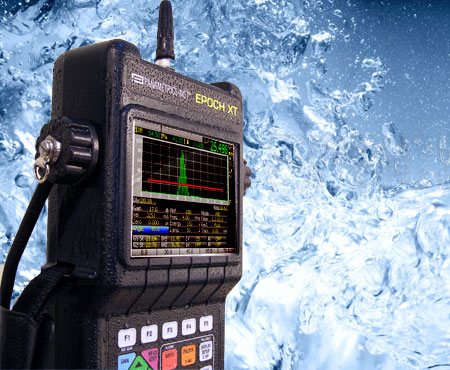
ポータブル超音波/渦流探傷器

EPOCH XT


EPOCH XT: 最新の超音波探傷器

数多くの機能を標準装備した高性能な超音波探傷器です。調整可能な矩形波パルサー、選択可能な狭帯域および広帯域のデジタルフィルターなど。

Panametrics-NDT新型 EPOCH XT超音波探傷器は、あらゆる検査に柔軟に対応でき、かつ過酷な環境下での使用に対応できるよう設計されています。 EPOCH XTは、IP67規格に準拠した密封ケースの小型ユニットに多数の探傷と測定機能、高輝度マルチカラーLCD、多様なバッテリーオプション、強力なデータ管理機能、多数のソフトウェア機能を搭載しています。

主な特長

  • EN 12668-1 に準拠
  • IP67規格に適合 過酷な環境にも耐えうる気密設計
  • 強力な DAC/TVG を標準搭載
    • ダイナミックDAC
    • 警告レベル線の任意選択
    • ASMEとJIS 規格に準拠
    • アドバンスTVGテーブルによりTVGのカスタマイズが可能
  • 多様なバッテリーオプション - リチウムイオンバッテリー/NiMHバッテリー/乾電池
  • ダイレクトプリントとUSBドライブへの保存を可能にするホストUSBポート
  • PC送受信用のクライアントUSBポート
  • "PerfectSquare™ テクノロジ": ピークおよび立ち上がりエッジの両方でパルスを電子制御することにより、探触子のパフォーマンスと近距離分解能を強化
  • PRFは10 Hz から 1 kHzまで10 Hz ごとに増加.。 すべての測定が簡単な操作で可能
  • パワフルな英数字のデータロガー
    • 腐食厚さ計のファイル形式を内部設定
    • 容易にファイルを追加
  • マルチカラーLCDディスプレイ
  • 軽量 2.1 kg

便利な計測機能を装備

EPOCH XTは、整調可能な矩形波パルサーや選択可能な狭帯域および広帯域デジタルフィルタ、0 から 110 dBまでのゲインレンジ、ピークメモリとピークホールド、調整可能なPRF、0.01 mmの 計測分解能およびプログラム可能なアラーム設定付きの2つのゲートなど、多彩な標準計測機能を備えています。 また、このユニットは標準仕様およびオプションでアプリケーションに特化したソフトウェア機能を提供します。:ダイナミックDAC/TVG (距離振幅補正/時間軸振幅補正)、オンボードDGS/AVG、AWS D1.1と D1.5、曲面補正、GageView Pro

  • PerfectSquare™ テクノロジによる整調可能な標準矩形波パルサーにより、パルス幅を調整し、探触子のパフォーマンスを最大化することが可能
  • 標準仕様デジタルレシーバフィルタリング-広帯域/いくつかの狭帯域設定/ハイパスフィルタ設定
  • 検査要件に対応できるようカスタマイズ可能な5つの計測表示として、 各ディスプレイボックス毎にゲート1またはゲート2の計測を選択
  • フルスクリーン高0.25% の振幅分解能
  • フルスクリーン高0%から110%までの振幅表示
  • ゲート計測モード: ピーク、エッジ、厚さ計アプリケーション用の新ファーストピークモード
  • ライブスクリーン上で10 Hzから1000 Hzまで、10 Hz毎に増加する調整可能な測定レート
  • すべての検波モードにおいてピークメモリとピークホールド機能 。RFモードでもピークホールドが可能
  • 新グリッド表示モード
    • 標準1~10
    • ビーム路程距離
    • 斜角検査用スキップ表示
    • 選択可能な振幅表示 (100%または110%)
  • 各ゲートごとにスキップ表示と計測モード表示
  • 各ゲートごとにアラーム表示

新ダイレクトアクセスキーパッド

  • 最適に構成されたカラーキーパッド
  • 重要な機器設定パラメータへのダイレクトアクセス
  • 英数字文字の直接入力
  • カスタマイズ可能な5つのファンクションキーにより、設定値を迅速な操作が可能
  • 英語、国際記号、日本語、中国語

複数のバッテリーオプション

EPOCH XTは、3つのバッテリーオプションを備え、ディスプレイ輝度とバッテリーの選択に応じて長時間の駆動が可能です。

  • 内蔵充電式 : リチウムイオン、NiMH電池またはアルカリ乾電池
  • 外部高性能バッテリー充電器

過酷な環境に対応

丈夫なEPOCH XTはIP67の規格に適合。 このユニットは、多湿環境から塵・砂の多い厳しい環境での現場作業に耐えることができます。

  • BNCコネクタ仕様では、P67規格に沿った密封設計
  • 広範囲な使用温度範囲:
    • リチウムイオンバッテリー: -10° から 50°Cまで
    • NiMHバッテリー: 0° から50°Cまで
    • アルカリ電池: -10° から50°Cまで
    • 充電時温度: 0°から40°Cまで
  • ストラップは、左もしくは右手操作用に取付け変更可能
  • 使いやすいゴム付きパイプスタンドは、折り曲げや取り外し可能
  • 首にかけて使用できるDリングを装備した耐久性の強いユニット
  • 密封バッテリー部:バッテリー交換には、ツールが一切不要
  • ACアダプタとUSB接続用のI/O端子は密閉
  • LEMOコネクタ採用:Oリング ゴムシール付き (ただし、この構成はIP67に適合していません)

豊富な文書作成機能とデータ管理能力

GageView Pro

オプショナルの GageView Proインターフェイスプログラムにより、保存した測定データを管理しフォーマット化を容易にします。 データの印刷もしくは、文書処理ファイルや詳しい集計表へのコピー・ペーストが、簡単に行えます。 GageView Proインターフェイスプログラムはまた、カスタマイズされた識別(ID)文字のデータベースを作成し、EPOCH XTにアップロードすることができます。 ライブスクリーンキャプチャモード、データベースバックアップ、保存、マルチビューウィンドウズなど新機能も搭載。 インターフェイスプログラムは、EPOCH 4、4B、4PLUS、LTおよびXTと完全に互換性があります。

  • EPOCHに保存された厚さや波形データをExcelやWord等のプログラムにエクスポート可能
  • 検査データベースを作成、フォーマット化と管理
  • リアルタイムスクリーンスナップショットをインポート
  • EPOCHとPCにおける設定をインポートおよびエクスポート
  • カスタムDGSプローブライブラリを作成
  • EPOCH操作ソフトウェアをアップグレード

2つのUSBポート

  • コンピュータへの高速データ移送のためのUSBクライアントポート
  • USBポート使用のプリンタに直接接続可能、またはUSBドライバなどへ重要な測定データのバックアップのための USBホストポート
  • USB接続とAC入力アダプタは、蝶ねじによる開閉可能なドアにより密閉

ハードウェア入力/出力ポートオプション

  • オプショナル16ピンHW I/Oポート
    • アラーム出力
    • トリガー入力/出力
  • 16ピンI/Oケーブル対応
    • PN: EPXT-C-16HW-6 (6 feet)
    • PN: EPXT-C-16HW-20 (20 feet)

データロガーと文書作成

EPOCH XTの洗練されたデータロガーは、多くの探傷検査と厚さ測定に応用できる幅広い機能を提供しており、簡単に操作できるよう設計されています。 EPOCH 4シリーズとPanametrics-NDT腐食厚さ計の技術を採用したEPOCH XTは、検査や厚さ測定調査の要件に適しています。
ニーズに合ったファイルタイプ:

  • EPOCH 4タイプファイル
  • シーケンシャル
  • 2D、2D EPRI
  • 2D custom point
  • 3D
  • Boiler

EPOCH XTはまた、オンボード報告書自動作成機能も搭載しています。 カスタムリポートヘッダーを設定し、USBホストポートを使い直接印刷することができます。

EPOCH XT 製品仕様*

概観
EN12668-1準拠
寸法(H × W × D): 277 mm × 150 mm × 51 mm (持手部分), 71 mm (画面部分)
キーパッド: 英語、国際記号、日本語または中国語
言語: 英語、スペイン語、フランス語、ドイツ語、イタリア語、日本語、中国語、ロシア語、韓国語、ノルウェー語、スウェーデン語 カスタム言語の使用が可能
探触子接続: BNC (IP67に適合)または大 LEMO
バッテリー: リチウムイオン、NiMHまたはアルカリ乾電池
バッテリー稼働時間:
リチウムイオン: 9~10時間
NiMH電池: 5時間
乾電池: 1~2時間
電源: 100 VAC~120 VAC、200VAC~240 VAC、50 Hz~60 Hz

環境適合評定
防塵・防水保護等級IP67 設計(BNCコネクタのみ)**

ディスプレイ
カラー液晶表示: 60 Hz更新、カラースキームと輝度の調整、画面分割モードまたはフルスクリーンモードの選択が可能
画面サイズ(W×H): 320ピクセル × 240ピクセル、101 mm ×75 mm
ベースラインブレイクモード: すべてのRF波形のゼロ交差を全波モードのゼロ交差のように表示
振幅グリッドモード: 100%または110% FSH振幅にて表示
時間軸グリッドモード: 標準は、0から10までの分割で表示。ビーム路程距離モードでは、レンジをグリッド線に沿って5つのセクションに等分割。スキップ表示モードでは、スキップをグリッド線として表示

パルサー
調整可能な矩形波パルサー
PRF: 10 Hzから1000 Hz(選択可能または自動)
電源設定: 50 Vから475 V( 25 V毎に増減)
パルス幅: PerfectSquare™テクノロジにより25 nsから5,000 ns (0.1 MHz)。調節可能
ダンピング: 50、63、150、400オーム

レシーバ
ゲイン: 0から110 dB(ユーザー設定で2つのゲインステップ調整とプリセットが可能)
全機器帯域幅: 0.2~26.5 MHz @ ~3 dB
デジタルフィルタ設定:
• 0.2 MHz~10.0 MHz • 2.0 ~ 21.5 MHz
• 0.2 ~ 1.2 MHz • 5.0 ~15.0 MHz
• 0.5 ~ 4.0 MHz • 8.0 ~ 26.5 MHz
• 1.5 ~ 8.5 MHz
検波: 全波、+半波、-半波、RF
直線性: 時間軸l: ±0.2% FSW,振幅: 0.25% FSH、アンプ精度: ±1 dB
リジェクション0から80%(フルスクリーン高さおよび警告表示)

校正
音速とゼロオフセットのための自動距離校正
テストモード: パルスエコー、デュアルまたは透過
単位: ミリメートル、インチまたはマイクロセカンド
レンジ: 1.86 mmから13400 mm(鋼音速の場合)
音速: 635から15240 m/s
ゼロオフセット: 0 µsから4950 µs
ディレイ(遅延): -59 mm から12700 mm(鋼音速の場合)
屈折角: 10° から85°(0.1°ステップ)

計測
タイプ :厚さ、ビーム路程距離、Y距離、深さ、振幅、 ゲート1とゲート2間のタイムオブフライト
エコーtoエコー: 標準
5つの計測表示区域:ライブスクリーン表示で、各ゲートにユーザー選択で5つの計測表示が可能
DAC/TVG 標準: 50ポイントまで設定可能。ASME、ASME III、JIS、80-20%、 カスタム DACおよびTVGテーブル 110 dBダイナミックレンジは、µs ごとに100 dB調整、フルゲイン、レンジ、設定中の遅延調整など、DAC/TVG使用中の変換が可能
カスタム DACは、 +10 dB toから‐24 dBまで、3本の警告レベル設定可能
TVGテーブル表設定は、TVG設定をDGS/AVGダイアグラムから行うことが可能 (最先端の時間可変ゲインアプリケーション用として)
振幅表示分解能: 0.25%(0から110%FSHにて)
曲面補正は、斜角測定標準仕様
X値補正は、ビーム入射点から探触子表面までの距離を補正

ゲート
エコー高さとタイムオブフライト測定のための2つの完全に独立したゲート
ゲート開始: 全表示レンジ内を可変
ゲート幅: ゲート開始位置から最大表示レンジ内で可変
ゲート高: 2%から95%(フルスクリーン高)
アラーム: ポジティブおよびネガティブ閾値; ゲート1およびゲート2における最小深さ
ズーム: 表示はゲート1

入力/出力
USBクライアントポート: GageView Proとの通信用
USBホストポート: USBドライブでのデータ保存と同様に、PCL5互換レーザまたはインクジェットプリンタへのダイレクト印刷用
LEMOハードウェアI/O (オプション): アラーム出力、トリガーIn/Out

データ保存
波形、計測値、そして設定パラメータにて10,000 IDまで


保証
1年限定保証
標準付属品
EPOCH XT 基本ユニット付属品:
- EP4/MCA: AC アダプタ
- EPXT-TC: 輸送用ケース
- EPXT-MAN: 取扱説明書
- EPXT-HS:ハンドストラップ(左右方向可能)
- EPXT-PS: ゴムコートステンレス製パイプスタンド
- リチウムイオンまたはNiMHバッテリー
- 探触子コネクタ用キャップ

オプションの付属部品
- EPXT-EC: 外部スマートバッテリー充電器
- EP4/CH: 胸用ストラップ
- EPXT-RPC: ゴム製保護ケース
- EPXT-DP: クリアディスプレイプロテクタ (10)
- EPXT-C-16HW-6: ダイアグラム付き16ピンハードウェア I/Oケーブル
- EPXT-HWIO-B, L: ハードウェア I/Oオプション
- EPXT-SEAL-KIT: O-Ringsと保護膜
- EPXT-EW: 1年間の保証延長サービス
- DGS/AVG (PN: EPXT-DGS-AVG)
- AWS D1.1/D1.5 (PN: EPXT-AWS)
- GAGEVIEW PRO (PN: GAGEVIEWPRO-KIT-USB)

ソフトウェアオプション
DGS/AVG (PN: EPXT-DGS-AVG)
AWS D1.1/D1.5 (PN: EPXT-AWS)
GAGEVIEW PRO (PN: GAGEVIEWPRO-KIT-USB)

Software Options

Remote Activation
EPOCH series advanced software options remotely activated at any time after acquiring the instrument. There is no need to send the instrument back for updates.

Availability On Instrument
The availability for each option on the various EPOCH series instruments is defined using the following key:

Available/Optional Available/Optional Not available Not available Standard Standard

EPOCH Series
Software Modules XT4+44BLT
API 5UEAvailable/OptionalAvailable/OptionalAvailable/OptionalAvailable/OptionalAvailable/Optional
AWSAvailable/OptionalAvailable/OptionalAvailable/Optional
ADTAvailable/OptionalAvailable/OptionalAvailable/Optional
Onboard DGS/AVGAvailable/OptionalAvailable/OptionalAvailable/Optional
Spotweld AssistantAvailable/OptionalNot availableNot available
Interface GateAvailable/OptionalNot availableNot available
High Pulse Repetition FrequencyAvailable/OptionalNot availableNot available
Low Pulse Repetition FrequencyAvailable/OptionalAvailable/OptionalAvailable/Optional
Floating GateAvailable/OptionalAvailable/OptionalNot availableNot available
Curved Surface CorrectionAvailable/OptionalNot availableAvailable/Optional
Spotweld OverlayAvailable/OptionalNot availableNot available
AutofreezeAvailable/OptionalNot availableNot available
Backwall AttenuatorAvailable/OptionalNot availableNot available
Wave AnalysisAvailable/OptionalNot availableNot available
Echo to EchoAvailable/OptionalStandardStandard
Narrowband FiltersAvailable/OptionalStandardNot available
Square Wave PulserAvailable/OptionalAvailable/OptionalStandard
Extended RangeAvailable/OptionalStandardStandard
Expanded MemoryAvailable/OptionalStandardStandard

API 5UE

Available/Optional Available/Optional Available/Optional Available/Optional Available/Optional
EPOCH XT EPOCH 4+ EPOCH 4 EPOCH 4B EPOCH LT

API 5UE - The API 5UE software option for the EPOCH series is intended to assist with performing inspections in accordance with the American Petroleum Institute's Recommended Practice 5UE. This practice was developed specifically for OCTG manufacturers to inspect and characterize inner-diameter (ID) cracking in newly fabricated pipe. The API 5UE code uses two crack sizing methods to characterize ID cracking: the Amplitude Comparison Technique (ACT) and the Amplitude-Distance Differential Technique (ADDT). The software aids in performing the ADDT method, which is based on the formula:

d i=Amax(T 2-T 1)k

API 5UE inspections are accomplished using the Peak Memory function on the EPOCH 4 flaw detectors to draw a peak envelope of the crack signal and quickly capture the Amax, T1 and T2 points using a single key press. Using this collected data from the peak envelope, the EPOCH flaw detector performs the necessary calculation using the formula above and displays the crack height in the upper right corner of the screen.

The ADDT inspection method can also be performed using the API 5UE software in a manual mode, allowing the operator to manually select the values for Amax, T1 and T2. All API 5UE data can be easily stored using the EPOCH 4 series datalogger, and the full inspection data can be downloaded to a PC using the EPOCH 4 series interface program, GageView Pro.

AWS

Available/Optional Available/Optional Available/Optional Available/Optional Available/Optional
EPOCH XT EPOCH 4+ EPOCH 4 EPOCH 4B EPOCH LT

AWS - The AWS D1.1/D1.5 software option for the EPOCH series is intended to assist with performing inspections covered under the American Welding Society D1.1 and D1.5 Structural Welding Code for steel. This code provides inspectors with a method to classify discontinuities found in welds using ultrasonic inspection. This code uses the following formula to develop an indication rating for a reflector found during an inspection:

A - B - C = D

A = Discontinuity Indication Level (dB)
B = Reference Indication Level (dB)
C = Attenuation Factor: 2 * (soundpath in inches - 1 inch) (dB)
D = Indication Rating (dB)

An AWS D1.1 inspector must take the Indication Rating (D) that is calculated based on A, B, and C to an Ultrasonic Acceptance - Rejection Criteria table produced by the AWS in order to classify the severity of the discontinuity that has been located.


AWS Indication Ratings are displayed in the upper right corner of the A-Scan display, as seen above. Once a proper angle calibration has been performed, the operator selects a reference indication and stores this indication gain level is as the "B" value using the AWS software option. All indications captured after this setup are assigned a "D" value automatically, eliminating the need for manual calculations. All data from AWS D1.1/D1.5 inspections can be saved and recalled at a later time using the EPOCH 4 series datalogger, including setup parameters, indication screen shots, and the values of A, B, C and D for each saved indication.

ADT

Standard Available/Optional Available/Optional Available/Optional Available/Optional
EPOCH XT EPOCH 4+ EPOCH 4 EPOCH 4B EPOCH LT

ADT - The Advanced DAC/TVG (ADT) software option is intended to significantly enhance the functionality of the standard DAC/TVG options already available on the EPOCH series flaw detectors, allowing users to customize inspections to their unique application requirements. The ADT feature incorporates the high-quality capabilities that adhere to ASME, ASME-3 and JIS sizing codes of standard DAC/TVG options with direct control of gain, range and zero offset, as well as reference and transfer correction. In addition, the ADT option provides new features such as 20%-80% DAC curves, customizable DAC curves, and a user-defined TVG table to meet advanced and unique inspection needs. ADT also allows the user to toggle between DAC and TVG views in many of its functions, allowing the operator the freedom to utilize both techniques during a single inspection.

Advanced DAC Options ADT's enhanced Distance Amplitude Correction functionalities allow more user control over the information acquired and displayed while sizing flaws compared to known reflector amplitude returns. A DAC curve is used to plot amplitude variations of signals from reflectors of the same size, but at different distances from the surface. A single DAC curve is used to plot the peak amplitude of each reflector at different depths within a material to compare with peak amplitude returns from unknown flaws. In the ASME-3 criteria, three DAC curves are plotted: one at peak amplitude, one 6dB below this point (indicating a reflector 50% the size of the reference), and one 14dB below the peak amplitude point (indicating a reflector that is 20% the size of the reference). Advanced DAC takes this functionality many steps further. The operator now has the option to customize up to three DAC curves at user-defined levels between +6dB and -24dB from the primary DAC curve. Additionally, since DAC curve inspections are not valid in most applications when a reflector is below 20% of full screen height, the ADT software allows a new dynamic 20%-80% function, which automatically adjusts the gain of reference signals below 20% up to 80% during setup. This allows a great range for inspections while minimizing the necessary manual gain adjustment. Should gain adjustment be necessary, the Advanced DAC and TVG functions now have a reference correction feature that provides the operator with a digital amplitude measurement of reflectors that is directly compared to the DAC curve level, even with significant gain adjustment during the measurement.

Custom DAC Curves (+6dB, -10dB, -18dB)
20%-80% DAC Feature
ASME-3 DAC Curve
ASME-3 DAC Curve in TVG View

Additionally, any DAC curve or curves set up using the standard or advanced functions are now interchangeable with TVG tables with a single push of a button.


Advanced TVG Options In addition to providing all the options from Advanced DAC in a TVG display for seamless integration of the two sizing techniques, the ADT software now offers a customizable TVG Table option for direct access to TVG point adjustment. This new feature allows fine manual adjustment of any captured TVG points, both for gain and position, as well as manual entry of new TVG points. The TVG Table is also completely compatible with the 1kHz High PRF option on the EPOCH 4 and EPOCH 4 PLUS instruments, as well as the Interface Gate option on those instruments, allowing for specialized fast scanning and on-line inspections previously out of reach of the EPOCH 4 series instruments.

TVG Table with Individual Point Adjustment
Resulting TVG Inspection Reference Definition

Onboard DGS/AVG

Available/Optional Available/Optional Available/Optional Available/Optional Available/Optional
EPOCH XT EPOCH 4+ EPOCH 4 EPOCH 4B EPOCH LT

Onboard DGS/AVG - The Onboard DGS/AVG option is a replacement for the old DGS/AVG option that has been available in the EPOCH 4 and 4 PLUS, which required a PC Interface Program for DGS/AVG setups. This new option allows complete DGS/AVG setups to be performed on the instrument.
The DGS/AVG method allows the operator to size defects based upon a calculated DGS/AVG curve for a given transducer, material, and reflector size, and has been designed to meet the requirements of EN 583-2:2001. This method requires that the operator only has one reference reflector in order to create a DGS curve for flaw sizing. This is much different than the DAC or TVG method which requires that the operator have representative defects at various depths within a part in order to create a curve for flaw sizing.
To allow the operator to setup DGS/AVG curves on the instrument very quickly, Olympus has developed a transducer library that is stored in the instrument's memory. All of the required data for building DGS/AVG curves is stored in the instrument's memory for each transducer in the library. The onboard DGS/AVG option provides the operator with rapid setup times and easy flaw size evaluation.

After activating the DGS/AVG software option and selecting the appropriate transducer from the probe library, the operator is walked through a series of instrument setups to display the DGS/AVG curve that correctly corresponds to the operator's particular inspection. These steps include defining a reference reflector, entering adjustment parameters for the critical flaw size of the inspection and entering parameters to compensate for material attenuation of the test piece and calibration block.
Upon proper completion of the instrument setup, the operator simply captures the reference reflector, and the DGS/AVG option displays the correct DGS/AVG curve on screen, along with any warning curves defined in the DGS/AVG setup parameters. When capturing potential defects, the DGS/AVG software displays the defect size evaluation in the upper right corner of the A-Scan display, allowing immediate and easy assessment of flaws. The software also permits adjustment of gain levels, which automatically adjust the displayed DGS/AVG curves, for more accurate inspection of potential defects.

DGS/AVG Curve and Warning Curve Capturing a Defect
Gain Adjustment in DGS/AVG Mode

Spotweld Assistant

Not available Available/Optional Not available Not available Not available
EPOCH XT EPOCH 4+ EPOCH 4 EPOCH 4B EPOCH LT

Spotweld Assistant (SWA) - The Spotweld Assistant software option is only available with the EPOCH 4 PLUS flaw detector, and is intended to provide automated weld quality analysis using a combination of the industry-proven Spotweld Overlay functionality with an advanced quality analysis algorithm. This software feature greatly enhances the EPOCH series' capability to inspect and characterize spotwelds with improved efficiency and accuracy.

Ultrasonic inspection of spotwelds involves the analysis of what is known as the "ring-down" of sound energy within the weld nugget. Unlike many direct-measurement techniques, spotweld inspection looks at the characteristics of the multiple echoes returned from sound ringing within the weld nugget to determine the quality of the weld. Echo spacing, sound attenuation, and intermediate echo detection are some of the indicators of weld quality analyzed by trained inspectors. Ultrasonic spotweld inspection is completely based on comparison between known "Good" and "Unweld" conditions with unknown welds, and requires a highly trained operator to perform a comprehensive inspection.

"Unweld" Reference Condition

"Good" Weld Reference Condition

The Spotweld Assistant is not intended to remove the necessity of a trained operator; instead, it is meant to enhance the ability of a trained operator to judge welds more efficiently. The operator begins by storing both a "Good" and "Unweld" reference condition into the EPOCH 4 PLUS to calibrate these control situations. The software then uses default comparative algorithms to rate unknown welds based on these stored conditions. If the trained operator disagrees with the software's recommended weld rating, the operator can override this rating manually.

SWA Automated Weld Rating


For more advanced users, the operator is able to manually adjust the comparative algorithmic parameters, such as Attenuation Analysis, Intermediate Echo Detection and Echo Spacing characteristics to allow a more customized and a higher quality automated weld-quality rating system.

The Spotweld Assistant option also has advanced features associated with the GageView Pro interface program. Using GageView Pro, the user can set up a full spotweld inspection plan. The operator can pre-define ID values for all welds to be inspected, all required SWA calibrations, and Memos reminding the operator to change transducers when calibrations change. The EPOCH 4 PLUS is capable of storing all weld rating information, including calibrations, waveforms, weld rating suggestions, and any operator weld rating overrides for recall and reporting purposes.


GageView Pro Inspection Plan


Exported SWA Excel File

Interface Gate

Available/Optional Available/Optional Available/Optional Not available Not available
EPOCH XT EPOCH 4+ EPOCH 4 EPOCH 4B EPOCH LT

Interface Gate - The Interface Gate option is designed to graphically compensate for the change in a water path distance or other delay between the test material and transducer. When the option is activated, a third gate (Interface Gate) is visible on the EPOCH's display. You can position this Interface Gate in the area where you expect to detect the interface echo. The interface echo is a result of the sound energy reflection at the interface between the water path and the front surface of the test material. The Interface Gate maintains the interface echo on the left hand side of the EPOCH screen, regardless of the water path distance, thereby maintaining a precise "acoustic" zero from which the instrument makes digital measurements. The instrument's flaw gates (Gate 1 and 2) automatically track the location of the Interface Gate. The Interface Gate can be used in standard measurement mode or in Echo-to-Echo mode.


The Interface Gate is mainly used in immersion applications where the water path distance between the front surface of the test material and transducer face is continuously changing. The application may involve an "on-line" type approach with the test material moving steadily past a stationary transducer, or vice versa. If the front surface of the test material is not uniform, that causes slight differences in the water path distance.

High Pulse Repetition Frequency

Standard Available/Optional Available/Optional Not available Not available
EPOCH XT EPOCH 4+ EPOCH 4 EPOCH 4B EPOCH LT

High Pulse Repetition Frequency (PRF) - In many "on-line" immersion applications, the inspection pieces are passed by the transducer at a fast pace compared to normal, manual scanning. If proper care is not taken, this can result in an effect known as "interleaving". This occurs when a pulse is transmitted into the test material, but the transducer moves prior to the return signal, and it can result in the loss of important data. To compensate for this effect, the High PRF option is used to hold the rate at which a pulse is transmitted into the test material at a high value (1,000 Hz). This is commonly used in conjunction with the Interface Gate option for "on-line" immersion inspection of parts moving quickly by a fixed transducer.

Low Pulse Repetition Frequency

Standard Available/Optional Available/Optional Available/Optional Available/Optional
EPOCH XT EPOCH 4+ EPOCH 4 EPOCH 4B EPOCH LT

Low Pulse Repetition Frequency (PRF) - The Low Pulse Repetition Frequency option is available on all of the EPOCH series instruments, and is designed to hold the pulse repetition frequency (PRF) of the instrument to a fixed setting of 30 Hz. This option is commonly used in inspections that deal with materials that have very long sound paths, and is intended to avoid a phenomenon known as "wrap-around noise". When inspecting a piece with a long sound path at normal "Auto" PRF, there is a point when the time the sound takes to make a full round-trip from pulse to receive is longer than the time between pulses. If a test setup produces multiple echoes, then the issue is the length of time required for the last multiple echo to arrive at the receiver. Normally, the instrument builds a waveform response by pairing a certain pulse with its return signal and analyzing the characteristics of the return signal. However, in this situation, the received signal does not correspond to its initial pulse (according to the instrument's timing algorithm). The overall affect is the potential for random noise and echoes on the A-Scan display. The Low PRF software feature slows the pulsing of the unit and allows for a certain pulse to be correctly paired with its return signal.

Floating Gate

Not available Available/Optional Available/Optional Not available Not available
EPOCH XT EPOCH 4+ EPOCH 4 EPOCH 4B EPOCH LT

Floating Gate - The Floating Gate software allows the operator to track and make measurements from A-Scan echoes at either the -6dB or -12dB point. After activation and setup, the gate "floats" at either of these points and tracks changes in the amplitude of a captured signal. This feature is intended to take more consistent, precise readings, especially in Edge Detect mode, by always taking measurements from the same relative amplitude of an echo. The feature also helps to maintain constant measurements in scanning applications where quality of transducer coupling may vary. The Floating Gate software is included with the B-Scan software, and is commonly used in conjunction with Edge Detect mode and B-Scan to maintain the accurate acquisition of measurements from corroded pipe and other materials. Floating Gate can also be used with the Interface Gate to track amplitude changes in the interface echo.

Curved Surface Correction

Standard Available/Optional Available/Optional Not available Available/Optional
EPOCH XT EPOCH 4+ EPOCH 4 EPOCH 4B EPOCH LT

Curved Surface Correction - The Curved Surface Correction software is intended to adjust digital measurements from a curved inspection surface during angle beam inspection, to compensate for curvature effects on sound path length. The algorithms built into the EPOCH instruments to calculate sound path (V-path) distance, surface (skip) distance, and depth of a reflector when performing angle beam inspection are written for flat surfaces, such as welded plates. The measurement calculations are different in curved surfaces, such as pipes and cylinders, due to the more complex geometry of the part. Therefore, a separate algorithm has been written, the Curved Surface Correction, that requires the operator to input the outer diameter of the test piece and then calculates the correct V-path, skip distance and depth of a reflector. All other calibration settings, including verification of refracted angle and part thickness, must be entered correctly for accurate measurements.

Spotweld Overlay

Not available Available/Optional Available/Optional Not available Not available
EPOCH XT EPOCH 4+ EPOCH 4 EPOCH 4B EPOCH LT

Spotweld Overlay - The Spotweld Overlay software option provides stored templates for comparison of unknown spotweld conditions to known Good, Stick, Undersized, and other known weld conditions. Upon activation, the operator uses the five soft keys (F1-F5) on the EPOCH to store templates of known weld conditions. These templates can then be recalled to the screen over an unknown weld condition under interrogation (in live A-Scan or Freeze mode) for comparison purposes. Although this option was specifically designed for Spotweld inspection, its template and comparison capabilities can be used in a variety of applications.

Autofreeze

Not available Available/Optional Available/Optional Not available Not available
EPOCH XT EPOCH 4+ EPOCH 4 EPOCH 4B EPOCH LT

Autofreeze - The Autofreeze software option allows the operator to automatically freeze the live A-Scan when a gate alarm is triggered. This function is typically used in scanning applications or applications with signals that are difficult to obtain and/or maintain because of coupling or orientation issues. The operator activates a gate alarm and sets the gate parameters to capture only echoes of interest, and any echo that breaks the gate and triggers the alarm automatically activates the screen freeze function. This allows the operator to thoroughly inspection signals that may be difficult to catch or maintain in a live screen.

Backwall Attenuator

Not available Available/Optional Not available Not available Not available
EPOCH XT EPOCH 4+ EPOCH 4 EPOCH 4B EPOCH LT

Backwall Attenuator - The Backwall Echo Attenuator software option is only available in the EPOCH 4 PLUS, and is designed to independently adjust the gain in a screen range region defined by the Gate 2 start point and beyond. The Backwall Echo Attenuator option is commonly used with two specific forms of inspections, both dealing with very small defects. The first is an inspection where potential defects may not be oriented parallel to the direction of sound from the transducer. In this situation, sound will reflect from the defect but not return to the transducer due to the orientation of the reflector. Therefore, such defects are detected by monitoring for backwall signal loss or attenuation. This backwall amplitude change may be missed entirely if the backwall signal is saturated. The Backwall Echo Attenuator option allows the operator to monitor the backwall at a lower gain setting for any signal loss, while still scanning the remainder of the test piece at a high gain level for small defects. The second common inspection for the Backwall Attenuator is in porosity inspection. Because porosity tends to scatter sound instead of return a clear echo, backwall amplitude is sometimes the only way to positively differentiate porosity from material grain structure. The Backwall Echo Attenuator is again used to bring the entire backwall signal on screen to be closely monitored by the operator.

Wave Analysis

Not available Available/Optional Available/Optional Not available Not available
EPOCH XT EPOCH 4+ EPOCH 4 EPOCH 4B EPOCH LT

Wave Analysis - The Wave Analysis software option allows the operator to make precise point-to-point measurements from any two points along a waveform. This option activates to indexing arrows that trace the length of the visible waveform in the A-Scan view. Typically, the operator will capture a single echo waveform using the instrument gate and use the zoom function to view the waveform close up. The Wave Analysis software then allows the operator to trace the entire waveform with two arrows and take a measurement between these two arrows. A common application for the Wave Analysis software is the measurement of oxide scale on the opposite surface of a pipe or tube. The backwall echo is captured and zoomed using the instrument gate, and the Wave Analysis arrows are used to measure the distance between the peaks representing the inner and outer surfaces of the oxide layer, as seen below.

Echo to Echo

Available/Optional Available/Optional Available/Optional Standard Standard
EPOCH XT EPOCH 4+ EPOCH 4 EPOCH 4B EPOCH LT

Echo to Echo - The Echo-to-Echo software option allows the user to make a digital measurement between two echoes captured in Gate 1 and Gate 2 on the instrument. This common measurement technique is used to increase the precision of thickness readings by measuring between multiple echoes of a single thickness inspection, eliminating any couplant layer or surface condition discrepancies. This technique is also used to get a clear measurement from a near-surface echo that is obscured by the ringing of the main bang in its first reflection(s).

Narrowband Filters

Available/Optional Available/Optional Available/Optional Standard Not available
EPOCH XT EPOCH 4+ EPOCH 4 EPOCH 4B EPOCH LT

Narrowband Filters - Narrowband Filters allow the operator to variably tune out unwanted or unnecessary ultrasonic frequencies being received from the test piece into the EPOCH. This filtering can significantly better the signal-to-noise ratio of the A-Scan, particularly in non-homogenous or scattering materials. The Narrowband Filters have preset ranges to encompass commonly used transducer frequencies, but with the Advance User Filter setting from the EPOCH settings menu, the Filters can be tuned to custom low- and high-pass settings for optimization of the option's capability.

 Square Wave Pulser

Available/Optional Available/Optional Available/Optional Available/Optional Standard
EPOCH XT EPOCH 4+ EPOCH 4 EPOCH 4B EPOCH LT

Square Wave Pulser - The Square Wave Pulser is a powerful tool to improve penetration and response of transducers, particularly with low frequency probes and in highly attenuating materials. Unlike the standard, negative spike pulser of most UT inspection units, the tunable square wave pulser matches the EPOCH's excitation pulse duration to the frequency of a particular transducer, allowing the transducer to ring closer to its natural resonance and increase the amplitude of the signal transmitting into the test material from the transducer. This is especially useful with lower frequency transducers, as the natural resonant period of lower frequency transducers is longer than that of higher frequency tranducers and a traditional spike pulse does not obtain optimal results at these longer resonance frequencies.

2.25Mhz Probe with Square Wave Pulser
2.25MHz Probe with Spike Pulser - 12dB Difference!

Extended Range

Available/Optional Available/Optional Available/Optional Standard Standard
EPOCH XT EPOCH 4+ EPOCH 4 EPOCH 4B EPOCH LT

Extended Range - The Extended Range option increases the standard measurement range of the EPOCH LT and EPOCH 4B from 0.16 inches - 200 inches (4mm - 5,000mm) to the extended range of 0.038 inches - 400 inches (1mm - 10,000mm).

Expanded Memory

Available/Optional Available/Optional Standard Standard Standard
EPOCH XT EPOCH 4+ EPOCH 4 EPOCH 4B EPOCH LT

Expanded Memory - The Expanded Memory option increase the memory capacity of the EPOCH LT, EPOCH 4B and EPOCH 4 to allow the storage of more waveforms/calibrations and/or thickness readings. The memory is expanded according to the table below:

Expanded Memory Capacity Standart Memory Capacity
Thickness Readings 40,000 10,000
Waveforms 2,000 500

GageView™

The GageView and GageView Pro Interface Programs are Windows-based applications that collect, create, manage, and print data from Olympus thickness gages and flaw detectors.

GageView is compatible with gage models 35DL, 35DLHP, and MG2-DL. It provides the following capabilities:

  • Creating Datasets and Surveys
  • Editing stored data such as thickness data
  • Viewing Dataset and Survey file information including thickness readings, waveform, gage setup values, and transducer setup values
  • Downloading and uploading thickness surveys to and from the Panametrics ultrasonic thickness gages
  • Exporting Surveys to spreadsheets and other programs
  • Collecting snapshot screens (graphical data sent by a thickness gage that duplicates the exact screen display)
  • Printing reports such as Thickness, Setup Table, Statistics, Color Grid, and others
  • Upgrading gage operating software

GageView Pro is compatible with flaw detector models Epoch 4, Epoch 4B, Epoch LT, Epoch 4 PLUS, and Epoch XT, as well as the gage models listed above. When used with flaw detectors, GageView Pro provides the following capabilities:

  • Exporting thickness or amplitude data saved on the Epoch to Excel, Word, or similar programs
  • Create, format, and manage test databases
  • Export real-time screen snapshots, including B-scans, to a PC or printer
  • Import and export setups between the Epoch and a PC
  • Set up inspection plan templates, including pre-loaded probe calibrations, IDs, and memos
  • Create a custom DGS probe library
  • Upgrade Epoch operating software

EPOCH XT with inspector inspecting a pipe, with buggy

Our advanced digital ultrasonic flaw detector, the EPOCH XT, offers a fully encoded B-scan option that displays scanned thickness measurements of internally corroded pipe or tank walls as easy-to-read cross-sectional images. This time-saving B-scan option works with multiple crawlers and encoders providing important transducer location information of distance traveled. Complete with thickness markers the B-scan option provides readings at specific scan locations and the ability to automatically save A-scans for minimum thickness data or when triggered by alarm conditions.

Features

  • Bi-directional, uni-directional, and manual scan modes
  • Ability to simultaneously view A-scan and B-scan
  • Scanning resolution up to 0.020 in. (0.5 mm)
  • Fast scanning rate (variable based upon operator selectable resolution) of 20 in./sec. (500 mm/sec) with a resolution of 0.020 in. (0.5 mm)
  • Automatic audible alarm if scan speed exceeds limit
  • Operates in all test modes including Time Varied Gain (TVG) and Floating Gate
  • Floating Gate improves precision and consistency of thickness readings
  • Ability to save a single screenshot or an entire B-scan
  • Internal storage of up to 150,000 B-scan thickness readings per scan
  • Ability to scroll and review internally stored B-scan data
  • Audible and visual Minimum Depth Alarm for thickness below an operator defined level
  • Minimum Thickness continuously captured and updated on screen

Powerful Software and Reporting Capabilities

Color-coded Scan Views

The EPOCH XT BSCAN software features color-coded scan views for striking visual feedback. Triggering a Minimum-Depth Alarm changes the scan color from green to red, immediately alerting the operator of a critically thin area of material. By selecting the Color Gradient view, the B-scan image gradually shifts from red to green over the full thickness of the inspection window, allowing the operator to visualize thickness variations across the entire inspection range!

Color Gradient View
Alarm Color Change

Includes Floating Gate Software Option

Included with the B-scan software is the Floating Gate software option. This option allows the operator to "float" Gate 1 and/or Gate 2 at a selected height compared to a gated echo (-1 dB to -14 dB). This feature is intended to allow more consistent, precise readings, and is especially useful while acquiring B-scan data in Edge Detect mode.

B-scan with Floating Gate

B-Scan Options Specifications*

B-Scan Standard Kit

EPXT-BSCAN-KIT-XX Includes:
EPXT-BSCAN: B-scan operating software for the EPOCH XT
EP4/ENC: B-scan Position Encoder
EPXT-ENC-CBL-XX: Position Encoder Cable with specified cable length. (Cable lengths available 10, 25, 50, and 100 feet)
Notes:

  • Panametrics D790-SM, 5.0 MHz, 0.434 in. (11.0 mm) diameter, transducer sold separately
  • Panametrics BCMD-316-XXB or L1CMD-316-XXB transducer cables also sold separately
  • Transducer cables available in 5, 10, 25, 50, and 100 feet lengths
  • B-scan option can be added to existing EPOCH XT units remotely if the instrument is equipped with the Hardware I/O option.

Optional Accessories

EP4/ENC-PH: Probe holder assembly
EP4/MW: One pair of magnetic hold down wheels
EP4/EPB: Extension pole bracket
EP4/WC: Replaceable wear cap
EP4/EWC: Replaceable extended wear cap
GAGEVIEWPRO-KIT-USB: Interface Program on CD-ROM, includes USB interface cable

Encoder Specifications

Resolution: 50 pulses per inch (0.020 in. per reading) 2 pulses per mm (0.5 mm per reading)
Outputs: Standard quadrature position outputs, TTL/CMOS compatible
Power: Single +5 V supply provided by EPOCH XT
Connector: LEMO®, four conductor
Water Fitting: Bronze barbed fitting requires 5/32 in. (4.0 mm) ID tubing
Pipe Diameter: Minimum 3.0 in. (76.2 mm)
Dimensions: (L x W x H) 4.41 in. x 2.75 in. x 2.70 in. (111 mm x 69 mm x 68 mm)
Weight: 0.93 lb (425 g)
Construction: Rugged, sealed cast aluminum
Note: Other commercially available encoders or crawlers can be used with the EPOCH XT B-scan option.

Loading...

Inspection & Measurement Systems
English | 日本語 | français | 简体中文 | Deutsch | italiano | čeština | magyar | Tiểng Việt | Español | русский | polski | português | 한국어

フェイズドアレイ/ スキャナー

ポータブル超音波/渦流探傷器

インライン非破壊検査システム