Inspection & Measurement Systems

用途/事例

アプリケーションノート

ボイラ管内部の酸化膜計測

Application: Measurement of thickness of internal oxide scale in steam boiler tubing.

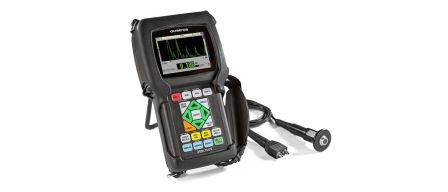
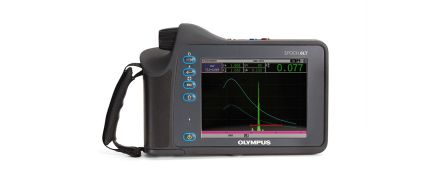
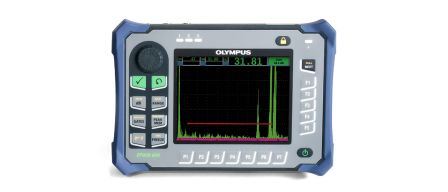
Recommended instruments: Model 38DL PLUS thickness gage with oxide measurement software option, EPOCH XT, Epoch LTC, Epoch 600, or Epoch 1000 flaw detector.

Background:
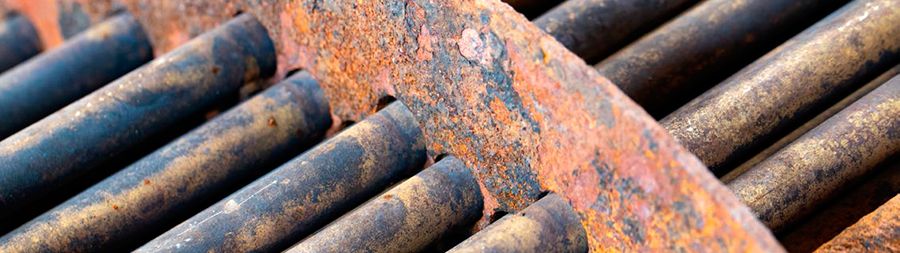
The very high temperatures found inside steam boilers (in excess of 1500 degrees Fahrenheit or 800 degrees Celsius) can cause the formation of a specific type of hard, brittle iron oxide called magnetite on the inside and outside surfaces of steel boiler tubing. At very high temperatures, water vapor will react with the iron in the steel to form magnetite and hydrogen according to the formula:

3 Fe + 4 H 20 = Fe 3O 4 + 4 H 2

The speed of this reaction increases with temperature. Oxygen atoms will diffuse inward through the magnetite layer, and iron atoms will diffuse outward, so the scale continues to grow even after the tube surface is completely covered.

Magnetite scale acts as thermal insulation on the pipe, since the thermal conductivity of scale is only about 5% that of steel. When heat can no longer transfer efficiently from the flame through the tube into the steam inside, the tube wall will heat up to temperatures beyond the intended operating range. Long term exposure to overly high temperatures, combined with the very high pressure inside the tube, leads to intergranular micro-cracking in the metal and to creep deformation (a slow swelling or bulging of the metal), which in turn eventually leads to tube failure by bursting.

A secondary issue is oxide exfoliation, in which pieces of oxide scale break off (usually due to thermal stresses during boiler startup or shutdown). These hard pieces will be carried by the steam flow into the turbine, where over time they will cause erosion damage.

The growth of magnetite scale and the associated metal damage are primary limiting factors with respect to boiler tube service life. The process begins slowly and then accelerates, for as the scale grows thicker the tube wall becomes hotter, and that in turn increases the rate of both scale growth and metal damage. Studies in the power generation industry have indicated that the effect of scale is relatively insignificant up to thicknesses of approximately 0.012" or 0.3 mm, but that beyond that thickness the negative effects of scale increase rapidly. Periodic measurement of scale thickness allows a plant operator to estimate remaining tube service life and to identify and replace tubes that are approaching the failure point. Ultrasonic testing provides a quick and nondestructive method for measuring scale. Hand-held, portable instruments such as the Model 38DL PLUS thickness gage or the EPOCH series flaw detectors can measure internal oxide layers down to a minimum thickness of approximately 0.125 mm or 0.005 inch.

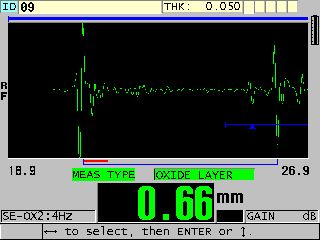
oxide scale 38DL PLUS screen
Typical internal oxide measurement with thickness gage and M2017 delay line transducer (zoomed)

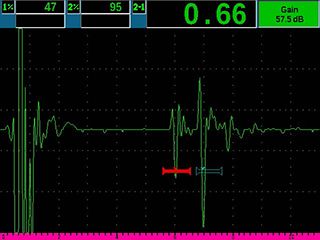
Typical internal oxide measurement with EPOCH XT flaw detector and M2017 delay line transducer, showing delay line echo at left of screen

Further detailed information on the subject of oxide scale and its effects on boiler tubing may be found in the book Metallurgical Failures in Fossil Fired Boilers by David N. French (John Wiley & Sons, 1983).

この用途に使用される製品

38DL PLUS

航空機エンジン検査認承:GE DFO P3TF22, P3TF30, P3TF31, P3TF35

EPOCH 1000 シリーズ

フェイズドアレイ機能(断面映像化)を搭載した高性能超音波探傷器です。

EPOCH 600NEW

高い性能と使いやすさにこだわった「ハイクオリティ&ユーザーフレンドリー」モデルの超音波探傷器です。

EPOCH LT

低価格ハンディータイプの超音波探傷器です。わずか38 mm(1.5インチ)の薄型探傷器です。

EPOCH LTC

わずか0.96 kgの堅牢でコンパクトな超音波探傷器です。マルチカラーVGAディスプレイ、PC用USB On-the-Go ポート、ダイナミックDAC/TVGは標準装備です。

EPOCH XT

数多くの機能を標準装備した高性能な超音波探傷器です。調整可能な矩形波パルサー、選択可能な狭帯域および広帯域のデジタルフィルターなど。

English | 日本語 | français | 简体中文 | Deutsch | italiano | čeština | magyar | Tiểng Việt | Español | русский | polski | português | 한국어