应用

应用注释

Ultrasonic time-of-flight-diffraction (TOFD) examination of butt-fusion joints of high-density polyethylene (HDPE)

Background

High-density polyethylene (HDPE) piping has been used in place of steels in the petrochemical, power, and mining industries due to its exceptional resistance to corrosion and erosion. Recently, HDPE has also been used for nuclear safety-related cooling water applications. The application of nuclear quality assurance requirements requires reasonable assurance that the production fusion joint is sound. Ultrasonic time-of-flight-diffraction (TOFD) inspection of fusion joints is an easily employed nondestructive examination tool that can be used to provide additional assurance of fusion-joint integrity.

Problem

The HDPE joint process is typically subject to the following flaws: lack-of-fusion, cold fusion (partial bond), inclusions (embedded), and voids. There is currently no consensus in the industry as to the nature and size of rejectable flaws; however, nondestructive examination is often requested to detect these conditions.

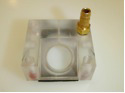
HDPE material has some specific characteristics that make its inspection difficult. Its acoustic impedance and sound velocity is similar to the materials commonly used in ultrasound wedges, which makes it difficult to achieve appropriate refraction of sound at the interface. In addition, coupling between the Rexolite wedges and the material can be difficult to achieve. Also, HDPE material is very attenuative as compared with metals, which often prohibits the use of higher ultrasonic frequencies. It also exhibits a natural high-frequency filtering effect. To overcome these hurdles, low-frequency probes mounted on TOFD Water Wedges are used.

Cross section of an HDPE fusion joint

Equipment

The following equipment is used for the inspection:

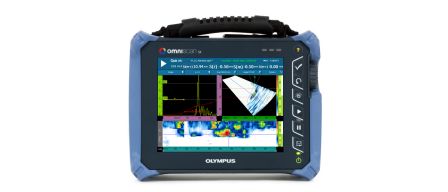
  • OmniScan MXU UT 2 Channel Instrument (or other TOFD-enabled MX unit)
  • Panametrics Preamplifier Model 5682 (500 kHz-30 MHz/30 dB)
  • Panametrics C542-SM or C546-SM Centrascan (6.25 mm or 0.246 in. element dia.; 2.25 MHz and 3.5 MHz frequencies)
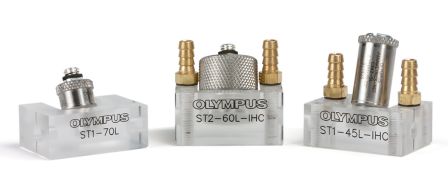
  • TOFD (ST1) 60L Water Wedges
  • 1 Chainscan Semi-automatic Scanner (X or XY version)
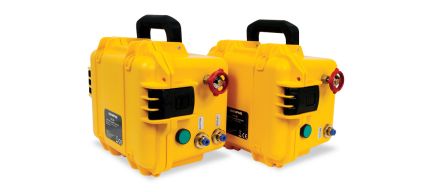
  • 1 CFU-03 or comparable water delivery system

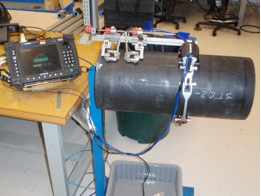
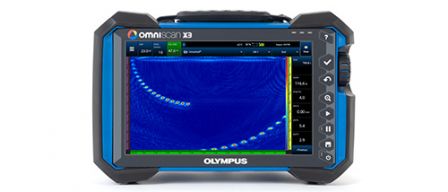
OmniScan MXU inspection set up
Inspection setup
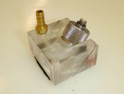
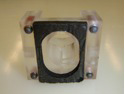
water wedge water wedge water wedge
Water Wedges

Typical procedure

A conventional TOFD procedure is used for the inspection of HDPE, with the following specifications:

  • The probe centering spacing (PCS) is adjusted to provide beam cross at 66% of the thickness. Additional configurations are recommended on thick-wall pipes to improve detection near the OD or ID surfaces.
  • The probe assembly is mounted on the Chain scanner.
  • Electronic gain on the OmniScan is adjusted to set the lateral wave (LW) signal at 60%.
  • The Chainscan is mounted on the pipe, and the inspection is performed in one rotation.

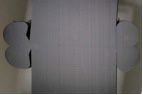
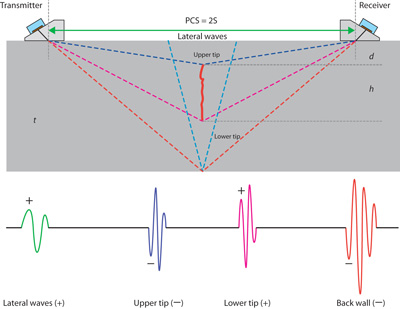
TOFD (time-of-flight diffraction) pattern of butt-fusion joint HDPE

Time-of-flight diffraction pattern of butt-fusion joint HDPE

Results

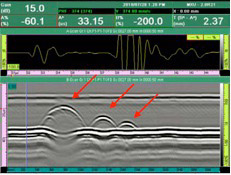
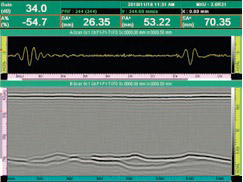
The screen capture below, with A-scan and circumferential B-scan images, shows the results on a 25 mm (1 in.) thick HDPE sample with ID calibration cuts ranging in depth from 11.6 mm (0.456 in.) to 2.9 mm (0.114 in.). The three inserted cuts are detected clearly with a good signal-to-noise ratio.

A-Scan screen

The following screen capture clearly shows the presence of voids and/or contaminants in the16 mm (0.629 in.) -thick HDPE butt-joint of a 150 mm (5.9 in.) diameter pipe.

Presence of voids on HDPTE butt-joint

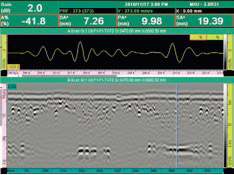
This image is indicative of a poor bonding condition at the inner wall through almost the entire diameter of a 54-mm (2.125 in.) -thick HDPE butt-joint of a 450 mm (17.716 in.) diameter pipe.

Poor Bonding Image

Conclusion

Use of TOFD in conjunction with the OmniScan and other appropriate tools has shown to be a valid method for nondestructive inspection of HDPE butt-fusion joints. While the nuclear industry continues to evolve with respect to detecting rejectable flaws, further studies and trials continue with the use of ultrasound phased array.

Products used for this application

5682

5682超声前置放大器提供超声信号的低噪声30 dB放大效果,范围为500 KHz到25 MHz。前置放大器装于结实防溅的外壳中,其机身小巧、重量极轻,是一款适用于远程应用的理想设备。

CFU耦合剂供给设备

CFU-03和CFU-05是两款用于在超声检测过程中为楔块持续提供耦合液体的电动泵设备。

CHAIN(链式)扫查器

CHAIN(链式)扫查器为外径在1.75英寸到38英寸范围内的管材提供手动管材检测方案。这款扫查器由链条而不是由磁轮支撑,非常适用于各种材料类型的焊缝或腐蚀检测应用。具有超声、TOFD、相控阵功能。

OmniScan MX UT

OmniScan MX UT可进行常规超声检测和自动检测,不仅支持编码B扫描、C扫描、完整的数据存储,还支持TOFD功能。这款仪器可同时使用TOFD和常规脉冲回波性能进行检测。

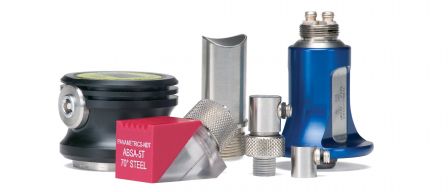
TOFD探头和楔块

TOFD探头和楔块可在钢中产生折射纵波,可用于通过衍射时差技术对裂缝进行定量的应用中。

超声探头

超声探头可以用于各种各样的应用,如:缺陷探伤、厚度测量、材料研究及医学诊断。具有各种晶片直径、频率和连接器类型的不同类型超声探头达5000多种。

Inspection & Measurement Systems
English | 日本語 | français | 简体中文 | Deutsch | italiano | čeština | magyar | Tiểng Việt | Español | русский | polski | português | 한국어

Advanced NDT Solutions

Flaw Detectors

Integrated Inspection Systems