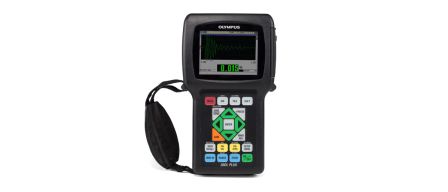
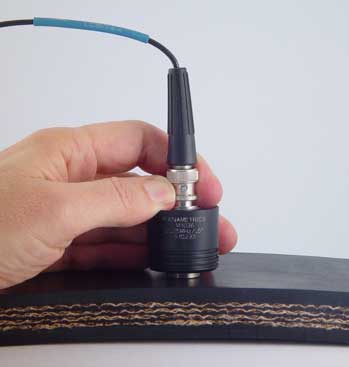
 Aplicación: Medición de la profundidad de los refuerzos en textil/tejido y acero en cintas transportadoras de caucho, y medición del espesor restante de caucho cuando dichas cintas se encuentran en servicio durante el mantenimiento. Aplicación: Medición de la profundidad de los refuerzos en textil/tejido y acero en cintas transportadoras de caucho, y medición del espesor restante de caucho cuando dichas cintas se encuentran en servicio durante el mantenimiento.
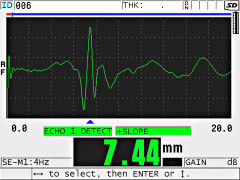
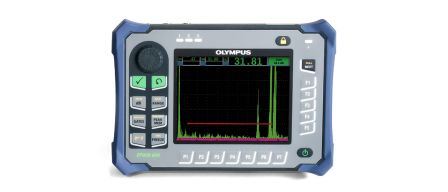
Contexto: Una gran variedad de cintas transportadoras de caucho, dedicadas a la industria pesada y a la minería (por ejemplo, para el transporte de minerales), incorporan capas internas de tejido o cordones de acero para reforzar su resistencia. Los fabricantes de cintas transportadoras necesitan controlar la profundidad de estas capas de refuerzo a lo largo de dichas cintas con el fin de asegurar el cumplimiento de las especificaciones del producto. Después de ser instaladas, los usuarios de las cintas transportadoras necesitan controlar periódicamente el espesor del caucho restante en ellas ya que las cintas se desgastan, y es imperativo estimar la vida útil restante de dichas cintas antes de reemplazarlas. Debido a que las cintas transportadoras pueden ser muy costosas, obtener una información apropiada con respecto al espesor de caucho restante es algo valioso para sus usuarios. Nuestros equipos y nuestras sondas han sido usados satisfactoriamente en este tipo de mediciones durante muchos años. La energía acústica se refleja en la primera capa de refuerzo; sin embargo, en el caso de cintas con textiles o tejidos reforzados, la energía acústica penetrará aún más. La medición del espesor completo de estas cintas, generalmente, es posible cuando algunos refuerzos de acero presentan una separación suficientemente ancha entre los cordones de acero, lo que permite una penetración ininterrumpida de la energía acústica hacia el lado opuesto de la cinta bajo inspección. Sin embargo, la dimensión crítica para varios usuarios es representada por la cantidad de caucho que se halla sobre la primera capa de refuerzo y no en el espesor total. Generalmente, esta es una aplicación sencilla que puede realizarse fácilmente con los medidores de espesores por ultrasonido. Equipos: Es posible medir cintas transportadoras que presenten un espesor de caucho de aproximadamente 12,5 mm o 0,50 pulg. con los medidores de espesores38DL PLUS y 45MG con la opción software Sonda monoelemento. Para obtener medidas más precisas de espesor, deberá usar la opción software de Alta penetración en estos equipos. Las mediciones de espesor también pueden ser llevadas a cabo con los detectores de defectos de la serie EPOCH. Es preferible usar los detectores de defectos de la serie EPOCH para medir grandes cintas transportadoras que presenten un espesor de caucho de 50 mm o 2 pulg. aproximadamente. La selección de la sonda dependerá del rango de espesor del caucho que debe ser medido. Para capas de caucho que presentan aproximadamente entre 1 mm (0,040 pulg.) y 6,25 mm (0,250 pulg.) de espesor, se recomienda usar la sonda de línea de retardo (M207-RB) de 2,25 MHz. Para medir capas de caucho que presentan aproximadamente entre 2,5 mm (0,100 pulg.) y 25 mm (1 pulg.) de espesor, se usa generalmente la sonda de contacto de alta penetración (M1036) de 2,25 MHz. Otros tipos de sondas están disponibles para medir capas de caucho más finas o más gruesas. Como en cualquier otra aplicación que implica la inspección de materiales atenuantes, se recomienda el uso del gel acoplante o la glicerina (acoplante B) en lugar de fluidos menos viscosos. Si una cinta transportadora presentase un desgaste severo, cualquier partícula de caucho o residuo debe ser limpiada de la superficie de dicha cinta antes de iniciar la medición. Procedimiento: En una situación normal, en la cual se usa la sonda M1036 para medir las capas de caucho externas en las cintas con refuerzos de textil/tejido, se inicia con la configuración por defecto del equipo para la sonda M1036. La ganancia máxima debe ser incrementada según sea necesario para medir el rango de espesor de su interés. Si desea medir cintas transportadoras delgadas, incremente también la ganancia inicial. Con cualquiera de estas configuraciones, la ganancia debe ser incrementada usualmente hasta el punto de que el equipo muestre una lectura falsa constante cuando la sonda no se encuentra acoplada a la cinta bajo ensayo, lo que significa que la ganancia es muy alta. 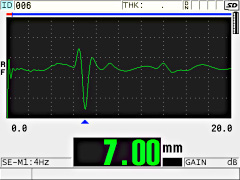 Medición típica con la sonda M1036 en cintas transportadoras
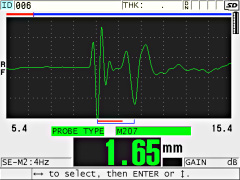
Para medir capas de caucho delgadas sobre refuerzos de textil/tejido con la sonda de línea de retardo M207, use la configuración predeterminada de la sonda M207 en el Modo 2 y ajuste la ganancia y el punto cero según sea necesario en base a los ecos provenientes del estándar de calibración.
La medición de la profundidad de los refuerzos hechos de cordones trenzados de acero puede ser más difícil, debido a los contornos irregulares que ofrece una superficie de reflexión disminuida. Se recomienda un ajuste exacto de la ganancia del equipo en base a la muestra de referencia. También, note que, la polaridad del eco será positiva en lugar de negativa debido a que el acero representa un reflector de alta impedancia.
La velocidad acústica en los componentes de caucho normalmente serán del orden de 1,650 mm/µS o 0,0650 pulg./µS. El Laboratorio de Aplicaciones de Olympus siempre está disponible para asistirlo con las configuraciones de sus equipos cuando son usados con sondas específicas y en cintas transportadoras. |


Control de espesor en cintas transportadoras de caucho reforzado

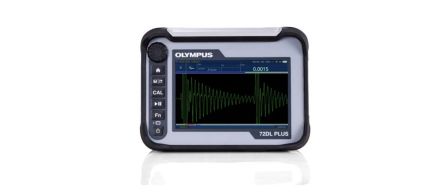
El medidor de espesores ultrasónico 72DL PLUS™ ofrece mediciones de espesor precisas y avanzadas a alta velocidad en un dispositivo portátil y fácil de usar. Compatible con sondas monoelemento de hasta 125 MHz, esta innovadora herramienta de medición de espesores es idónea para determinar el espesor de materiales ultrafinos, como la pintura, los revestimientos y el plástico de múltiples capas. Puede mostrar de forma simultánea el espesor de hasta seis capas.
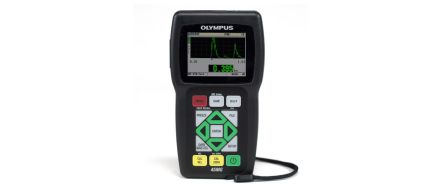
El 45MG es un avanzado medidor de espesores ultrasónico que cuenta con funciones de medición de serie y opciones de software. Está exclusiva herramienta de medición de espesores es compatible con nuestro rango completo de sondas duales y monoelementos dedicadas a medir espesores.