应用

应用注释

Thickness Testing of Reinforced Rubber Conveyor Belts

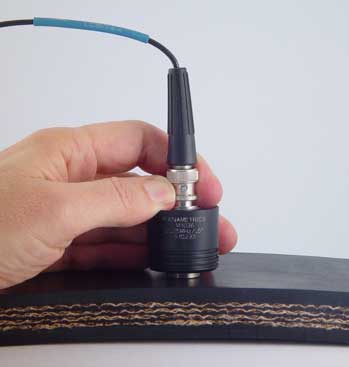
m1036 testing thinkness of rubberApplication: Measuring the depth of textile and steel reinforcements in rubber conveyor belts, and measuring the remaining rubber thickness of in-service belts.

Background: A wide variety of rubber conveyor belts for heavy-duty industrial and mining service such as ore and mineral transportation incorporate internal layers of woven fabric or steel cords for strength reinforcement. Conveyor belt manufacturers need to check the depth of the reinforcement layer across the belt in order to insure that the product meets specification. After installation, belt users need to periodically check the thickness of the remaining rubber as the belt wears down in order to estimate the remaining service life before replacement. Because large belts can be very expensive, accurate information on remaining rubber thickness is valuable to users. Our instruments and transducers have been successfully employed in this test for many years.

Sound energy reflects off the first layer of reinforcement, and in the case of textile or fabric reinforced belts very little sound energy will penetrate deeper. Measurement of total belt thickness is normally possible only in the case of some steel-reinforced belts where there is sufficiently wide separation between the steel cords to permit sound energy to travel unobstructed the opposite side of the belt. However, the critical dimension for most users is the amount of rubber over the first reinforcement layer, not total thickness. This is usually a straightforward application for ultrasonic thickness gaging.

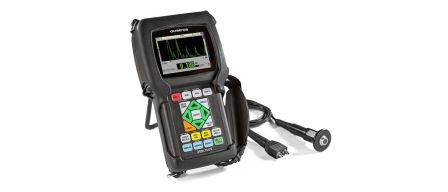
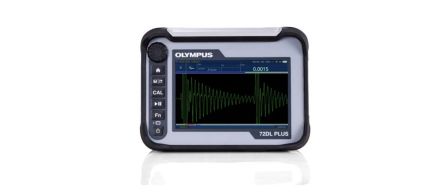
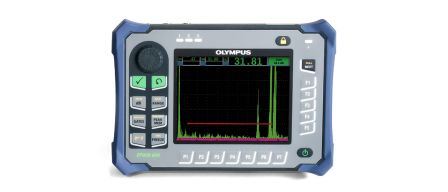
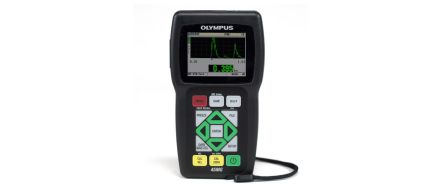
Equipment: Rubber thicknesses under approximately 20 mm or 0.750 in. can usually be measured with thickness gage models 35, 35DL, and 38DL PLUS. For greater thicknesses, the high penetration version of these gages (models 35HP, 35DLHP, and 38DL PLUS with high penetration transducer option) should be used. Thickness measurements can also be made with any of the Epoch series flaw detectors. In the case of certain very large belts, with rubber thicknesses approaching 50 mm or 2 in., the Epoch 4 is the preferred instrument.

The transducer selection will depend on the range of rubber thickness to be measured. For rubber layers between approximately 1 mm (0.040 in.) and 6.25 mm (0.250 in.), a 2.25 MHz delay line transducer (M207-RB) will usually be recommended. For measurement of rubber between approximately 2.5 mm (0.100 in.) and 25 mm (1 in.), a 2.25 MHz high penetration contact transducer (M1036) is commonly used. Other transducers are available for thinner and thicker rubber layers.

As with any application involving attenuating materials, use of gel couplant or glycerin (Couplant B) is recommended in preference to less viscous fluids. In the case of severely worn in-service belts, any loose rubber or other debris should be removed from the surface before testing.

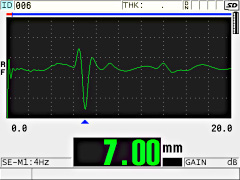
Procedure: In the most common situation, using the M1036 transducer to measure the outer rubber layers on belts with textile or fabric reinforcement, start with the gage's M1036 default setup and increase maximum gain as necessary to measure the thickness range of interest. If necessary for measurement of thin belts, increase initial gain as well. In any of these setups, gain may usually be increased up to the point where the gage displays a constant false reading when the transducer is uncoupled, which indicates that gain is too high.

measurement with M1036
Typical conveyor belt measurement with M1036

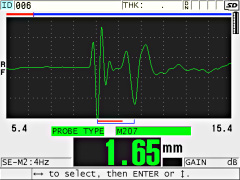
To measure thin rubber layers over textile or fabric reinforcement with the M207 delay line transducer, use the M207 Mode 2 default setup and adjust gain and blanking as necessary based on the echoes from a reference standard.

measurement with M207
Typical thin rubber layer measurement with M207

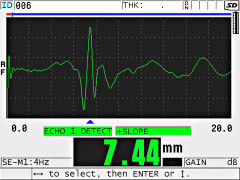
Measurement of depth of braided steel cord reinforcements can be more challenging because their irregular contour presents a less optimum reflecting surface. Careful adjustment of instrument gain with the aid of a reference sample is recommended. Also note that echo polarity will be positive rather than negative because the steel represents a high impedance reflector.

measurement with M1036
Steel cord depth measurement with M1036

Sound velocity in rubber compounds will typically be on the order of 1.650 mm/uS or 0.0650 in/uS. The Olympus NDT Applications Lab is always available to assist with gage setups for specific transducers and belt types.

Products used for this application

35

袖珍型35是一款手持式超声测厚仪。这款仪器使用单晶探头可对金属、塑料、橡胶、玻璃及复合材料进行精确的测量。具有宽泛的厚度范围:0.08毫米~635.0毫米(0.0030英寸~25.0英寸)。 具有可选的实时波形和调整模式功能。

35DL

袖珍型35DL是一款手持式超声测厚仪。这款仪器使用单晶探头可对金属、塑料、橡胶、玻璃及复合材料进行精确的测量。具有与35型仪器相同的功能,并带有内置数据记录器。

35DL-HP

袖珍型35DL-HP(高穿透)是一款手持式超声测厚仪,用于对纤维玻璃、铸铁和橡胶等较厚或声束衰减性较强的材料进行测量。使用单晶探头。具有与35型仪器相同的功能,并带有内置数据记录器。

38DL PLUS

38DL PLUS是一款高级超声测厚仪。这款仪器可使用双晶探头对内部腐蚀的部件进行检测。其性能包含THRU-COAT®(穿透涂层)和回波到回波。还可以使用单晶探头对薄材料、极厚材料以及多层材料进行非常精确的厚度测量。

EPOCH 1000系列

EPOCH 1000是一款高级常规超声探伤仪,可在授权的Olympus服务中心为其升级,使其具有相控阵成像功能。其主要特性包括:符合EN12668-1标准、37个数字式接收器滤波器选择、用于高速扫查的6 kHz脉冲重复频率。

EPOCH 600NEW

EPOCH 600是一款中级水平的手持式超声探伤仪。EPOCH 600仅重1.68公斤(3.72磅),机身横宽竖窄,机壳坚固耐用,可以在非常恶劣的检测环境中正常工作。EN12668-1型号仪器增加了400 V PerfectSquare可调方波脉冲发生器及用于加强信噪比的数字式滤波性能。

EPOCH LT

EPOCH LT是一款手持式初级数字式探伤仪,厚度仅为38毫米(1.5英寸),重量仅为1公斤(2.35磅),机身结构横窄竖宽,具有最小60 Hz的快速显示更新率、自动探头校准、数字式数据记录器等特点,以及许多其他测量功能。

EPOCH LTC

EPOCH LTC是一款中级水平的手持式超声探伤仪。这款小巧的仪器为横窄竖宽结构,仅重0.96公斤(2.12磅)。这款功能齐全的仪器符合EN12668-1标准,不仅具有各种标准的功能,还可附加满足用户的具体检测需求的特殊选项。

EPOCH XT

EPOCH XT是一款高级便携式超声探伤仪。具有很多标准测量功能,其中包括可调方波脉冲发生器、可选窄带和宽带数字式滤波器、0~110 dB的增益范围、峰值记忆和峰值保持、可调PRF。

Inspection & Measurement Systems
English | 日本語 | français | 简体中文 | Deutsch | italiano | čeština | magyar | Tiểng Việt | Español | русский | polski | português | 한국어

Advanced NDT Solutions

Flaw Detectors

Integrated Inspection Systems