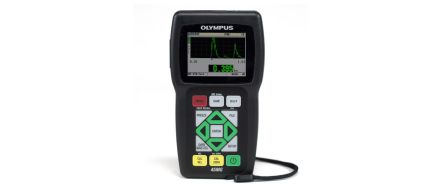
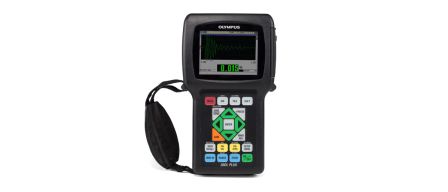
Ultrasonic thickness gauging is not just limited to materials at normal (ambient) temperatures. The thickness of a part can be measured even when the surface temperature approaches 900 deg F (500 deg C). In metals particularly there may be circumstances when the thickness of the part needs to be measured during an ongoing process where the test piece cannot be cooled down. Ultrasonic testing has the advantage - just as at normal temperatures - that thickness measurements can be taken from one side of the hot part. Ultrasonics may be the preferred method of measurement even when both sides of the hot metal part are accessible. The reason is that ultrasonic thickness measurements can be made instantly and with very brief contact with the hot surface. For the best calibrated accuracy, the effect of the higher temperature on the velocity of sound must be taken into account. Although change in sound velocity with temperature is much less in metals than in plastics, significant errors in measured thickness can result if sound velocity is not corrected. For measurement of smooth hot metal we recommend the Model 38DL PLUS, or Model 45MG with Single Element software, which can be used with delay line transducers or immersion transducers. On hot surfaces delay line transducers must be used with selected high temperature delay lines. The thickness of hot corroded metal parts or parts with rough surfaces should be measured with a D790 or D791 dual transducer. The 38DL PLUS and , 45MG gages can both be used for this purpose. |


Material didáctico
Notas de aplicación
Regresar al material didáctico
Ultrasonic Thickness Measurements of Hot Metals

Productos para la aplicación
El 45MG es un avanzado medidor de espesores ultrasónico que cuenta con funciones de medición de serie y opciones de software. Está exclusiva herramienta de medición de espesores es compatible con nuestro rango completo de sondas duales y monoelementos dedicadas a medir espesores.
El versátil medidor de espesores 38DL PLUS™ puede ser usado con sondas duales para medir el espesor de tuberías corroídas, como también para ejecutar mediciones de espesor muy precisas de materiales delgados o multicapa mediante el uso de una sonda monoelemento.
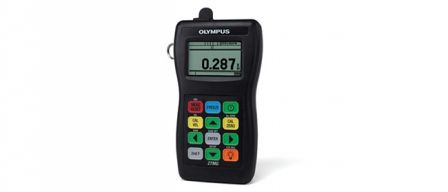
El 27MG es un medidor de espesores ultrasónico básico diseñado para medir espesores de forma fiable de piezas o tuberías metálicas internamente corroídas o erosionadas. Se dota de una estructura ligera, duradera y ergonómica para una fácil manipulación.
Lo sentimos, la página solicitada no se encuentra disponible en su país.
Let us know what you're looking for by filling out the form below.