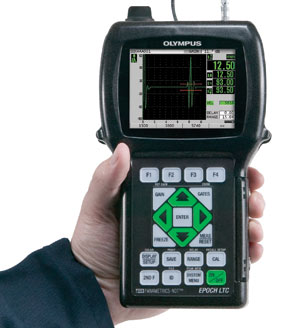
The EPOCH LTC is a mid-level, handheld ultrasonic flaw detector in a compact 2.12 lbs (0.96 kg) vertical case. It is a full-featured instrument with EN12668-1 compliance and a wide variety of standard features as well as specialized options to meet your inspection needs.
The EPOCH LTC Digital Ultrasonic Flaw Detector offers state-of-the-art technology in a package that is compact and lightweight 2.12 lbs (0.96 kg). Based on the design of the class-leading EPOCH XT, the EPOCH LTC is a full-featured instrument with EN12668-1 compliance and a wide variety of standard features as well as specialized options to meet your inspection needs.
Ultrasonic flaw detection is widely used for locating and sizing hidden cracks, voids, disbonds, and similar discontinuities in welds, forgings, billets, axles, shafts, tanks and pressure vessels, turbines, and structural components.
The instrument features a bright multi-color transflective display with full VGA (640 x 480) resolution providing a high resolution A-scan and superior visibility in all lighting conditions, including direct sunlight. The EPOCH LTC is also designed to the requirements of IP67, assuring that the instrument will perform in the harsh environments common in the inspection field.
The EPOCH LTC incorporates many standard features to meet your inspection needs. These include a square wave pulser, dynamic DAC/TVG, selectable digital filters, gain range from 0 to 110 dB, peak memory, 0.001 in. (0.01 mm) measurement resolution, and one gate with programmable alarms. In addition, the unit offers many optional application-specific software features: On-board DGS/AVG, Manual PRF Control, Pulse Width Tuning, GATE 2, Curved Surface Correction, and the GageView Pro Interface Program.
The EPOCH LTC can withstand the rigors of field operation in harsh environments from offshore to deserts.

The EPOCH LTC features a simple keypad design that allows full control from left or right hand, for direct access to important functions. Rapid parameter adjustments, and recall of instrument setup (CAL) files are quick and easy.
Available in English, International Symbols, Japanese and Chinese.
Four customizable function keys allow the operator to select preset values for instrument setup parameters.
Standard Dynamic DAC/TVG: Calculates signal amplitude as a percentage or dB level compared to a DAC curve or a reference echo amplitude fixed with Time Varied Gain. DAC versions include ASME, ASME 3, JIS, and Custom. Contains several key features including: dynamically adjustable?DAC curves, switchable DAC & TVG views, and custom DAC warning curves.
| The EPOCH LTC features a variety of I/O ports to meet your data management and training requirements. |
| USB On-The-Go: Dual purpose USB port that may be used for PC communication and for direct printing. |
| Mini SD Storage: Allows inspection data, instrument setup, and screen captures to be stored on a removable disc. |
| VGA Output: Allows the EPOCH LTC display to be projected or viewed on a standard PC monitor at full update rate (60 Hz) |
| RS-232 Port: Used to control the EPOCH LTC remotely with a PC. |
| USB to Host PC: (PN: EPLTC-C-USB-A-6) |
| USB to Client Printer: (PN: EPLTC-C-USB-B-6) |
| RS-232 6 Foot Length: (PN:EPLTC-C-RS232-6) |
| VGA 6 Foot Length: (PN:EPLTC-C-VGA-6) |
| General |
| EN12668-1 Compliant |
| Weight: 2.12 lbs (0.96 kg) with Li Battery |
| Dimensions: 8.79" H x 5.07" W x 2.17" D; 223.3 mm x 128.9 mm x 55.1 mm |
| Keypad: English, International, Japanese or Chinese |
| Languages: English, Spanish, French, German, Italian, Japanese, Chinese, Russian, Norwegian, Swedish |
| Transducer Connections: LEMO 00 |
| Battery: Rechargeable Lithium Ion. Pack for AA cells standard |
| Battery Operating Time:
- Lithium Ion Rechargeable Pack: 8 hours - AA Lithium Ion Cells: 6 hours - AA NiMH Cells: 4 hours - AA Alkaline Cells: 3 hours |
| Power Requirements: AC Mains 100-120 VAC, 200-240 VAC, 50-60 Hz |
| Environmental Ratings |
| IP67 Environmental Ingress Protection Rating |
| Explosive Atmosphere approved per: MIL-STD-810F, Procedure 1, NFPA 70E, Section 500, Class 1, Div. 2, Group D Shock Tested per: IEC 60068-2-27, 60 g, 6 msec H.S., 3 axes, 18 total |
| Vibration Tested: Sine Vibration per IEC 60068-2-6, 50-150 Hz @ .03" DA or 2 g, 20 sweep cycles |
| Drop Tested: MIL-STD-810F 4.5.5 Procedure IV - Transit Drop |
| Display |
| Color Transflective Liquid Crystal Display: 60 Hz update, user-selectable color schemes and brightness, two split screen modes and one full screen mode. |
| Display Dimensions: 640 Pixels (W) x 480 Pixels (H) 2.95" W (75 mm) x 2.21" H (56 mm), 3.7" (94mm) diagonal |
| Amplitude Grid Modes: 100% or 110% Amplitude Display |
| Time Base Grid Modes: Standard 0 to 10 division, Soundpath Mode divides Range into 5 equal sections with grid lines, Leg Mode displays Soundpath Legs as grid lines |
| Pulser |
| Square Wave Pulser: Fixed width square wave pulser optimized for general flaw detection applications. |
| Pulse Width: Fixed Width in Base Instrument. Adjustable from 25 ns to 5,000 ns (0.1 MHz) with EPLTC-SWP Option |
| Pulse Repetition Frequency (PRF): Automatically controlled by the instrument software over the range of 10 Hz to 500 Hz. Manual PRF control option available (PN: EPLTC-PRF) |
| Measurement Rate: 10Hz to 500Hz. Always equal to PRF rate. |
| Energy Settings: 100 to 400 V in 100 V increments |
| Damping: 50, 100, 200, 400 Ohm |
| Receiver |
| Gain: 0 to 110 dB - Two user-defined gain step adjustments and presets above function keys |
| Total Instrument Bandwidth: 0.2 - 26.5 MHz @ -3 dB |
| Digital Filter Settings: Standard: 0.2 - 10.0 MHz
Broadband: 2.0 - 21.5 MHz High Pass: 8.0 - 26.5 MHz |
| Rectification: Fullwave, Positive Halfwave, Negative Halfwave, RF |
| System Linearity: Horizontal: +/- 0.2% FSW |
| Vertical: 0.25% FSH, Amplifier Accuracy +/- 1dB |
| Reject: 0 to 80% full screen height with visual warning |
| Calibration |
| Automated Distance Calibration for Velocity and Zero Offset |
| Test Modes: Pulse Echo, Dual, or Through Transmission |
| Units: Millimeters, inches, or microseconds |
| Range: Base Instrument: 0.144 in. to 200 in. (4 mm to 5000 mm) |
| Extended Range Option: (PN: EPLTC-RANGE): 0.144 in. to 400 in. (4 mm to 10000 mm) |
| Velocity: 0.025 to 0.6000 in/µsec (635 to 15240 m/S) |
| Zero Offset: 0 to 750 µsec |
| Display Delay: -2.323" to Max Range (-59 mm to Max Range) |
| Refracted Angle: 10° to 85° in 0.1° resolution |
| Measurements |
| Types: Thickness, Soundpath, Projection, Depth, Amplitude, Time-Of-Flight for Gate 1 |
| GATE 2 option: (PN: EPLTC-GATE2): Allows Echo-to-Echo measurements independent of Gate 2 measurements, and Gate 2 alarms. |
| Four Measurement Display Locations: User selects up to four measurements from either gate to display on the live screen. |
| Dynamic DAC/TVG Standard: ASME, ASME III, JIS, and CUSTOM DAC with up to six warning curves. Allows dynamic adjustment of curves with Gain, Dynamic range 110 dB, Slope 100 dB/usec and up to 50 points captured. |
| Amplitude Measurement: 0 to 110% full screen height |
| X-Value Correction: Removes distance from Beam Index Point to front of transducer from surface distance measurement. |
| Gate 1: Measurement of Echo Height and Time-Of-Flight. |
| Gate Start: Variable over entire displayed range |
| Gate Width: Variable from Gate Start to end of displayed range |
| Gate Height: Variable from 2 to 95% full screen height |
| Alarms: Positive and Negative Thresholds; Minimum Depth |
| Zoom: Displayed Range is Gate 1 Width. |
USB: On-The-Go (OTG) Port for PC Communication, printing, and data storage with USB Drives
VGA Ouput Port: for connection with PC monitors and/or projectors
Mini SD: Card Slot for Data Storage
Data Storage Up to 50,000: IDs with Waveforms, Measurements, and Setup Parameters in onboard memory. Mini SD card allows virtually unlimited data storage.
EPOCH LTC Base Instrument Includes:
EPLTC-EW: Extended Warranty for one additional year.
DGS/AVG: (PN: EPLTC-DGS-AVG)
Manual PRF Control: (PN: EPLTC-PRF)
Extended Range: (PN: EPLTC-RANGE)
GATE 2 (ECHO-TO-ECHO): (PN: EPLTC-GATE2)
Tunable Square Wave Pulser: (PN: EPLTC-SWP)
Curved Surface Correction: (PN: EPLTC-CSC)
AWS D1.1/D1.5: (PN: EPLTC-AWS)
API 5UE: (PN: EPLTC API 5UE)
GAGEVIEW PRO: (PN: GAGEVIEWPRO-KIT-USB-A-AB)
Software Options |
| DGS/AVG: Flaw sizing technique that permits echo signals to be evaluated using a DGS/AVG diagram associated with a particular type of probe and material. The DGS/AVG diagram shows the relationship among echo height, flaw size, and distance from the transducer. (PN: EPLTC-DGS-AVG) |
| Manual PRF Control: Allows the operator to manually adjust the EPOCH LTC's pulse repetition frequency (PRF) from 10 Hz to 500 Hz in 10 Hz increments. (PN: EPLTC-PRF) |
| Extended Range: Extends the standard range of the EPOCH LTC to 0.144" to 400" (4 mm to 1000 mm) (PN: EPLTC-RANGE) |
| Gate 2 (Echo-to-Echo): Activates Gate 2 in the EPOCH LTC allowing Gate 2 measurements , Echo-to-Echo measurements and Gate 2 alarms.
(PN: EPLTC-GATE2) |
| Tunable Square Wave Pulser: Allows the operator to tune the pulse width of the square wave pulser to optimize transducer performance. This maximizes signal-to-noise ratio and penetration in difficult materials. (PN: EPLTC-SWP) |
| Curved Surface Correction: Corrects sound path information when using an angle beam transducer to circumferentially inspect a curved surface. (PN: EPLTC-CSC) |
| AWS D1.1 & D1.5: Provides a dynamic reflector "indication rating" for various AWS weld inspection applications. This allows for more efficient inspection by eliminating manual calculations. (PN: EPLTC-AWS) |
| API 5UE: Allows defect sizing according to API Recommended Practice 5UE. Uses the Amplitude Distance Differential Technique (ADDT) to measure the size of potential defects during the prove-up process of OCTG pipe. The measurement process is simple and repeatable since all ADDT variables are captured from a Peak Memory envelope. (PN: EPLTC-API5UE). |
The optional GageView Pro Interface Program helps manage and format stored inspection data. Data can be printed or easily copied and pasted into word processing files and spreadsheets for further reporting needs. The GageView Pro Interface Program also allows the creation of a customized database of identifier (ID) strings that can be uploaded to the EPOCH LTC. The Interface Program is fully compatible with the EPOCH 4, 4B, 4PLUS, LT, XT, and the 1000 Series.
With Gageview Pro the operator can:
Copyright 2011 OLYMPUS CORPORATION, All rights reserved. Condizioni d'uso | Informativa sulla privacy