Inspection & Measurement Systems

Applications

Notes d’application

Dickenmessung der Glasfaserummantelung von Schiffsrümpfen


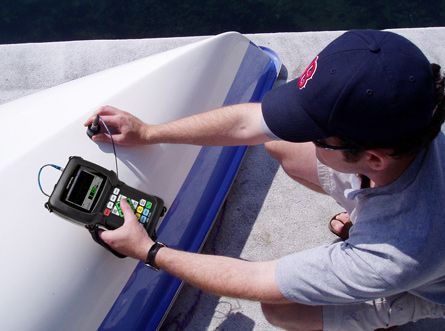
Background: Fiberglass Reinforced Plastic (FRP) is used extensively in the boating industry, both work boats and recreational craft. Boat manufacturers and marine surveyors need to obtain accurate hull thickness measurements, and traditionally, unless there was a place to put a micrometer, there was no way to determine thickness but to drill a hole in the hull. Nearly 30 years ago, Panametrics was the first company to develop a thickness gage and transducer (the Model 5227 and M2008 respectively) that were specifically designed to make digital thickness measurements from one side of the fiberglass. Since then, aside from many commercial applications, our instruments have been used by Olympic organizations to certify boats for international competition.

Ultrasonic thickness measurements are particularly useful with fiberglass mat/roving lay-ups. Variations in layer thickness make it necessary to periodically check thickness. Sometimes boat hulls are made of fiberglass skins sandwiched around an inner core of balsa wood, cork, or foam. The core material makes it impossible to make total hull thickness measurements, but individual fiberglass layers can be measured very effectively with ultrasonic equipment.

Equipment: The Panametrics Model 35DL-HP is a portable gage designed to make digital thickness measurements on fiberglass. It is commonly used with a M2008 transducer (500 KHz) to maximize penetration of ultrasound in thick or attenuating fiberglass, providing a thickness measurement range of approximately from 0.150 to 3 inches (4 to 75mm), depending on the type of fiberglass. The Model 35HP may be used in situations where data logging is not required. In especially challenging cases, the advanced Model 38DL PLUS with the high penetration transducer option and large waveform display is recommended, to permit on-site operator adjustment of setup parameters. Transducers such as the M1036 (2.25 MHz) or M109 (5 MHz) can measure down to approximately 0.050 inch (1.25mm) in fiberglass. The standard Model 35DL can often be used for thickness measurements on hulls less than 0.500 inch (12.5mm), particularly if the material is of good quality.

Procedure: The 38DL PLUS, 35DLHP, and 35HP gages all have pre-programmed default setups for the two transducers most commonly used for fiberglass measurement, the M2008 and M1036. In many cases these default setups can be used with no further adjustment, just the two-point velocity and zero calibration that is recommended for all ultrasonic thickness measurements.

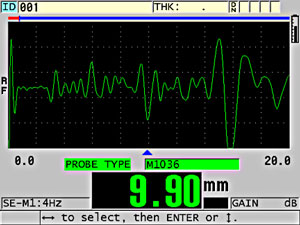
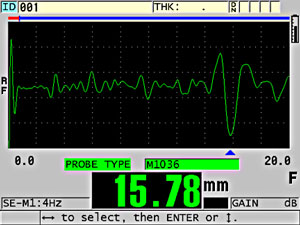
The fiberglass used in boat construction is generally of high quality, and unlike some other fiberglass laminates it usually does not produce high amplitude internal reflections that can cause false readings. However, if false readings are observed in a particular case, the situation can usually be corrected by small adjustments of initial gain and TDG slope as outlined in the gage operating manuals. The waveforms below show a typical hangup on internal reflections, and a correct reading of total hull thickness following a simple gain adjustment.


False reading due to hangup on internal reflections


Correct reading following gain adjustment

Any delaminations that may occur in the hull will appear as strong, well-defined reflectors accompanied by a complete loss of the backwall echo. While ultrasonic flaw detection should always be performed with instruments specifically designed for that purpose, such as the EPOCH series, a trained operator can use the waveform display of the Model 38DL PLUS gage to make initial judgments about the presence of delaminations in a hull.

Gelcoat measurement: A closely related application is measurement of smooth gelcoat applied over fiberglass. For detailed information on ultrasonic measurement of gelcoat thickness, please refer to the separate application note Measurement of Fiberglass Gelcoat.

Products used for this application

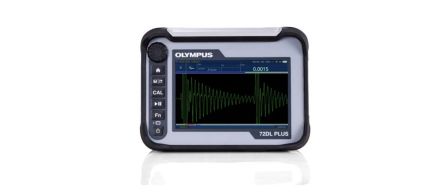
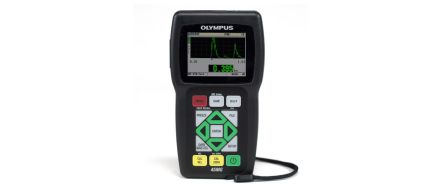
35DL

Le modèle 35DL de poche est un mesureur d'épaisseur à ultrasons portable pour les mesures de précision sur métal, plastique, caoutchouc, verre, composites qui utilise des sondes à ultrasons monoéléments. Il possède les mêmes caractéristiques que le modèle 35, mais il inclut un enregistreur de données interne.

35DL-HP

Le modèle 35DL-HP (haute pénétration) de poche est un mesureur d'épaisseur à ultrasons portable pour des mesures sur des matériaux épais ou à forte atténuation sonore tels que la fibre de verre, la fonte et le caoutchouc. Il utilise des sondes à ultrasons monoéléments. Il possède le mêmes caractéristiques que le modèle 35, mais il inclut un enregistreur de données interne.

35HP

Le modèle 35DLHP (haute pénétration) de poche est un mesureur d'épaisseur à ultrasons portable pour des mesures sur des matériaux épais ou à forte atténuation sonore tels que la fibre de verre, la fonte et le caoutchouc. Il utilise des sondes à ultrasons monoéléments. Il possède le mêmes caractéristiques que le modèle 35, mais il inclut un enregistreur de données interne.

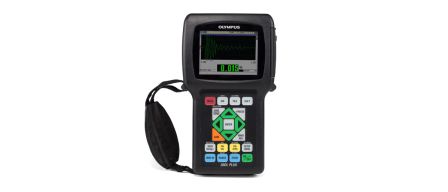
38DL PLUS

Le 38DL PLUS est un mesureur d'épaisseur à ultrasons de pointe. Il utilise une sonde à ultrasons à deux éléments pour des applications d'inspection de surfaces internes corrodées et inclut les fonctionnalités THRU-COAT et de mesure entre échos. Il utilise aussi des sondes à ultrasons monoéléments pour des mesures d'épaisseur très précise de matériaux minces, très épais, ou multicouches.

English | 日本語 | français | 简体中文 | Deutsch | italiano | čeština | magyar | Tiểng Việt | Español | русский | polski | português | 한국어