Aplicaciones

Application Notes

Cracking in Ceramic Diesel Particulate Filters
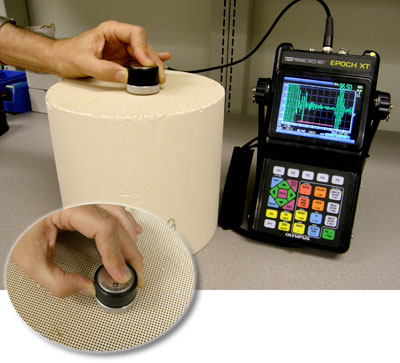
EPOCH XT testing ceramic

Application
Detection of internal cracking in ceramic diesel particulate filters.

Background
The use of ceramic particulate filters is well established as a method for removing environmentally dangerous soot and similar particulates from diesel engine exhaust, especially for diesel engines used in trucks and buses. These filters have the form of large cylinders, approximately 100 mm to 300 mm (4 in. to 12 in.) in diameter and 150 mm to 350 mm (6 in. to 14 in.) high. They are commonly made of cordierite, silicon carbide, or ceramic in a fine honeycomb pattern. As the hot exhaust is forced through the porous filter under pressure, soot particles collect on the surfaces of the honeycomb channels where they then break down or oxidize due to heat.

These complex ceramic structures can potentially crack during manufacturing, handling, or in service, causing reduced performance or failure that can cause both environmental and engine damage. Ultrasonic testing can quickly and nondestructively detect internal cracking in both new and used ceramic filter elements. The technique usually requires access to only one end of the cylinder.

Equipment
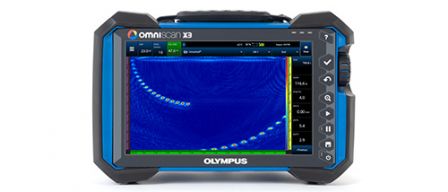
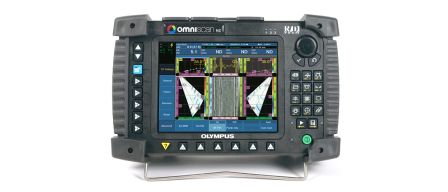
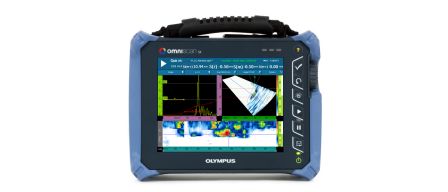
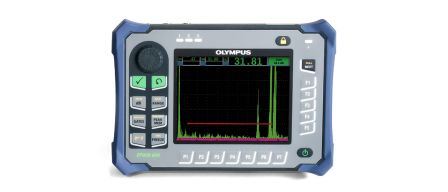
This test can be performed with both conventional flaw detectors and phased array instruments Any of the Epoch-series flaw detectors (Epoch LTC, Epoch XT, EPOCH 600, or Epoch 1000) can be used with a low frequency contact transducer such as an A601S-RB or V601-RB (500 KHz). A soft polymer membrane on the face of the transducer is used to couple sound energy into the filter without the need for liquid couplants that could be difficult to remove. The Advanced Filter option (available on the Epoch XT and standard on the Epoch 1000) can be helpful for improving signal-to-noise when testing larger filters by improving the instrument's low frequency response. Phased array testing can be performed with the Omniscan or Epoch 1000 and 1.5 MHz probes such as the 1.5L16-A4.

Procedure
Using firm hand pressure, the transducer is coupled to the end of the filter. High frequency sound energy propagating as plate waves travels through the ceramic honeycomb, reflecting off the far end if there are no discontinuities. If there is a crack parallel to the end surface, an echo will be received ahead of the point on the display representing the far end of the filter. If there is a crack that is tilted with respect to the ends, there may be no direct reflection but the echo from the far end will disappear.

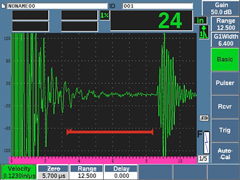
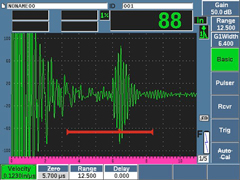
In the example below representing a setup with an Epoch XT and an A601S-SB transducer, the left screen image represents a typical echo pattern from an undamaged filter. The echoes at the left side of that waveform represent reverberations of the outgoing sound pulse, and the echoes at the right side represent the reflection from the far end. There should be no significant echoes in the zone in the middle that is marked by the red gate. The right screen image represents an echo pattern from a filter with two cracks parallel to the end, one approximately one-quarter of the way through and one halfway through. The large peak at the right side of that waveform has disappeared because sound energy is no longer reflecting from the far wall, and two new peaks corresponding to the cracks have appeared. The transducer can then be moved to as many points as desired on the face of the filter to check for cracks at other locations.

Typical Backwall Echo from Good Filter

Typical Backwall Echo from Good Filter

Typical Midwall Echoes from Cracked Filter

Typical Midwall Echoes from Cracked Filter

The specific instrument setup for each type of filter should be established through the use of a known good setup standard that is used to optimize the echo from the far end. By identifying the echo pattern from a good filter and looking for changes, a trained operator can quickly and reliably identify echo variations that correspond to internal cracks.

Phased Array Testing

OmniScan Testing

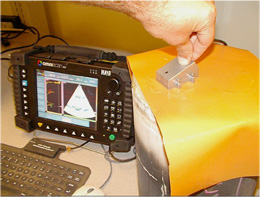
Phased Array can offer cross-sectional imaging of filters from either sectorial or linear scans. This can aid operator visualization of flaws. Automated testing has also been implemented using larger array probes and specialized fixturing.

Products used for this application

EPOCH 1000 Series

El EPOCH 1000 es un detector de defectos por ultrasonidos convencional de avanzada al que se puede optimizar adicionando la creación de imágenes phased array en un centro de servicio autorizado de Olympus. Sus características claves son: la conformidad a norma EN12668-1, un juego de 37 filtros digitales en el receptor y una frecuencia de repetición de impulsos de 6 kHz para la inspección a alta velocidad.

EPOCH 600NEW

El EPOCH 600 es un detector de defectos por ultrasonidos portátil de nivel intermedio. Su peso es de solamente 1,68 kg y su caja horizontal está construida para resistir a las exigencias de entornos extremadamente rigurosos. Responde a la norma EN12668-1 e incluye funciones como un emisor de ondas cuadradas ajustable de 400 V con tecnología PerfectSquare y el filtrado digital que mejora la relación señal-ruido.

EPOCH LTC

El EPOCH LTC es un detector de defectos por ultrasonidos portátil de nivel intermedio, de 0,96 kg de peso, alojado en una caja vertical compacta. Es un instrumento con todas las funcionalidades, conforme a la norma EN12668-1 y que ofrece una amplia variedad de características de serie y específicas en opción, para responder a sus necesidades de inspección.

EPOCH XT

El EPOCH XT es un detector de defectos por ultrasonidos portátil de avanzada, que cuenta con numerosas funciones estándares de medición, incluyendo un emisor de ondas cuadradas ajustable, filtros digitales de banda estrecha y de banda ancha seleccionables, una gama de ganancias de 0 a 110 dB, las funciones de memoria y de mantenimiento de picos y una frecuencia de repetición de impulsos (PRF) ajustable.

OmniScan MX PA

El OmniScan PA permite realizar inspecciones phased array manuales y automatizadas. Ofrece todas las funcionalidades de las pantallas A-scan, B-scan, S-scan y C-scan, así como el tratamiento de datos en tiempo real de avanzada. Permite configuraciones con elementos 16:128 y la posibilidad de 16:16M, 16:64M, 32:32 y 32:128

Inspection & Measurement Systems
English | 日本語 | français | 简体中文 | Deutsch | italiano | čeština | magyar | Tiểng Việt | Español | русский | polski | português | 한국어

Soluciones avanzadas de NDT

Detectores de defectos

Sistemas Integrados de Inspección