Inspection & Measurement Systems

应用

Application Notes

Measurement of Fiberglass Gelcoat

Application: Measuring the thickness of gelcoat over fiberglass.
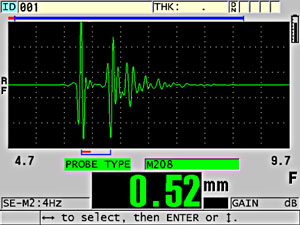
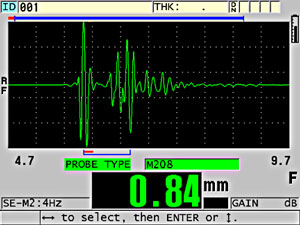
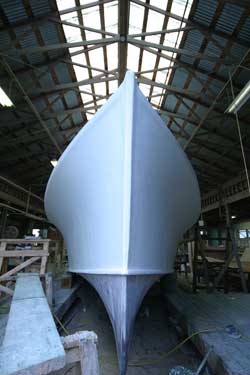
Background: Gelcoat is a hard polyester resin coating that is applied over structural fiberglass to provide a smooth, glossy protective surface that eliminates friction and improves appearance. It is most commonly used on fiberglass boat hulls and on bathroom fixtures such as sinks, tubs, and shower stalls. Manufacturers of fiberglass products need to measure gelcoat thickness to insure that it is within a specified range, and especially to detect situations where it is too thin because of insufficient application or shrinkage. Measurements typically involve a range of approximately 0.25 mm to 1 mm (0.010 in. to 0.040 in.), with most cases involving a nominal thickness of around 0.5 mm (0.020 in.).

Equipment: Gelcoat thickness can be measured with any of the following Panametrics-NDT thickness gages: Models 35 or 35DL. The waveform display that is available as an option on the 35 series, and that is standard on the advanced Model 38DL PLUS, is very useful for establishing echo quality and verifying readings.
Gelcoat is normally measured with a delay line transducer. The most commonly recommended Panametrics-NDT transducer is the M208-RM (20 MHz, 0.125 in. element). In cases involving thick gelcoat, the M202-RM (10 MHz, 0.25 in. diameter element) can also be used.

Procedure: This is set up as a Mode 2 measurement (interface echo to first backwall echo). The primary challenge is that the inside surface of gelcoat is usually rough and irregular, conforming to the surface profile of the fiberglass, and because of this non-uniform geometry the quality of the echo from the gelcoat/fiberglass boundary often varies widely from point to point. The first echo from that boundary may not be the largest, phase distortion may appear to invert echoes, and in some cases roughness may drop reflected echo amplitude below the detectable minimum. Also, the gelcoat/fiberglass boundary echo is usually followed by several other peaks representing scatter noise from within the underlying fiberglass, which if detected will cause erroneously high readings.

Because manufacturers are usually most concerned about insuring that gelcoat meets a minimum thickness specification, the recommended procedure is to make several readings within a small area and record the minimum reading obtained. If a the 35-series waveform option or a Model 38DL PLUS is used, then it is possible to verify whether the first returning echo (representing minimum gelcoat thickness) is being detected, by monitoring the waveform display as seen in the screen images below. If a Model 35 or 35DL is used without the waveform display option, it is particularly important to note the minimum reading within a local area. Any abrupt transition to a higher reading usually represents false detection caused by irregular echoes. As a general rule, gage gain should be set high to maximize the likelihood of detected the first returning echo.


Optimal gelcoat reading - first peak detected


Inaccurate reading - first peak not detected due to low amplitude related to inside surface roughness

Note: Measurement of total fiberglass thickness
In many cases, the same gage that is used for gelcoat measurement can also be used to measure total wall thickness (gelcoat plus fiberglass) using a second transducer, usually an M1036 (2.25 MHz, 0.5 in. element, high sensitivity). The maximum measurable fiberglass thickness will typically be approximately 12.5 mm (0.5 in.). For thicker fiberglass, a high penetration (HP) gage is usually required.

Products used for this application

35

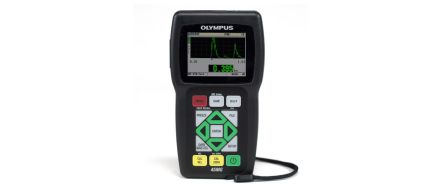
袖珍型35是一款手持式超声测厚仪。这款仪器使用单晶探头可对金属、塑料、橡胶、玻璃及复合材料进行精确的测量。具有宽泛的厚度范围:0.08毫米~635.0毫米(0.0030英寸~25.0英寸)。 具有可选的实时波形和调整模式功能。

35DL

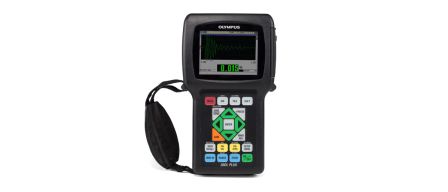
袖珍型35DL是一款手持式超声测厚仪。这款仪器使用单晶探头可对金属、塑料、橡胶、玻璃及复合材料进行精确的测量。具有与35型仪器相同的功能,并带有内置数据记录器。

38DL PLUS

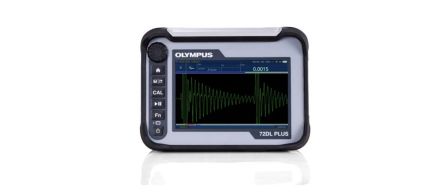
38DL PLUS是一款高级超声测厚仪。这款仪器可使用双晶探头对内部腐蚀的部件进行检测。其性能包含THRU-COAT®(穿透涂层)和回波到回波。还可以使用单晶探头对薄材料、极厚材料以及多层材料进行非常精确的厚度测量。

English | 日本語 | français | 简体中文 | Deutsch | italiano | čeština | magyar | Tiểng Việt | Español | русский | polski | português | 한국어