Inspection & Measurement Systems

应用

Application Notes

Inspection of Landing Gear

In today's aerospace market, the reliability of airplanes is more than ever a prime concern because airlines companies are trying to make their fleet last longer. To reach this goal safely, these companies must perform more inspections in order to ensure customer safety.

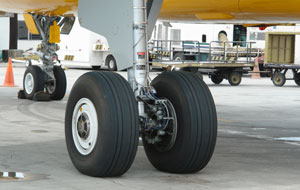
Some of the parts that have required inspection lately include landing gears, which are subject to intense stress upon takeoffs and landings. The section that must be inspected is a cylinder possessing three different diameters in the zone of interest. The best way to inspect that zone is to use a phased-array technique with steering capabilities to simultaneously fire 40- to 65-degree shear wave refracted angles in the part.
The adapted wedge and the combination of angles provided by the phased array system allow the complete inspection of the zone of interest in a single pass.
Some of the advantages of such a technique, in comparison to standard techniques, are the simplicity (performing a single one-line scan instead of a raster scan) and the ability to cover a complete volume using multiple angles at the same time. With this system, any inspector can perform the inspection faster and with better reliability.

Typical Inspection Requirements
  • Adapted probe and wedge to the curved surface
  • A-scan, B-scan, and sectorial scan displays
  • Storage of a one-line scan for analysis
  • Landing gear diameter: 5 in. (127 mm) to 8 in. (203.2 mm)
  • Part thickness: 0.5 in. (12.7 mm) to 1.5 in. (38.1)
  • User-friendly operating system
  • Portable system
  • Inclusion
  • Crack
Description of the Solution
  • Manual inspection using one small phased-array probe
  • One-line scan at around 12 mm/s (0.472 in.)
  • Inspection with 40- to 65-degree refracted angle
  • Real-time display of A-scan, B-scan, and sectorial scan
  • Storage of a one-line scan for analysis

Material Requirements

  • Omniscan MX acquisition unit (weld package)
  • 10-MHz, 32-element probe
  • Plexiglas® wedge with curve to fit the landing gear
  • Couplant

Inspection Method
The probe is configured to perform an azimuthal scan from 45 to 70 degrees in the OmniScan software. The display and gain level are adjusted on flat bottom holes, and ID and OD notches using a mock-up of the real landing gear.
The scan then performs one longitudinal scan around the landing gear. The image is frozen and analyzed using A-scans, B-scans, and sectorial scans. Finally, if the piece is rejected, the scan is stored and kept for records.

Products used for this application

OmniScan MX

OmniScan MX是一款使用多种技术的高级探伤仪。这款便携式模块化探伤仪具有极高的采集速率和强大的软件功能,可以进行高效地手动和自动检测。这款仪器可以使用PA和常规UT模块,以及常规EC和ECA模块。

OmniScan MX2NEW

具有触摸屏界面功能的OmniScan MX2相控阵探伤仪提高了检测效率,并具有强大的软件功能。使用这款仪器可以快速进行设置,缩短检测周期,并快速创建报告,从而保证了超水平的手动和高级AUT应用的特性。它与当前所有的相控阵模块都兼容。

English | 日本語 | français | 简体中文 | Deutsch | italiano | čeština | magyar | Tiểng Việt | Español | русский | polski | português | 한국어