应用

应用注释

Crevice Corrosion - Testing the Sealing Surface of Flanges

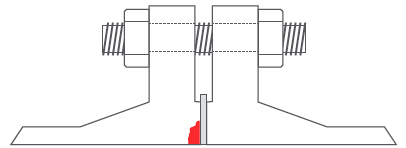
A known damage mechanism in industry is identified as "Crevice Corrosion". A concentration of corrosive materials or combinations of substance to form an aggressive corrosion solution in which is located at a specific point to accelerate damage is known crevice corrosion.

An example of this damage mechanism is the corrosion that occurs between seals on two opposing flanges with a gasket placed in-between the seals.

Concentrations of corrosive materials collect within a crevice such as between sealing surfaces and gasket material. Because of the concentration of the corrosive material in a localized area the rate of corrosion is accelerated. Corroding or loss of sealing area can cause loss of containment therefore potential for catastrophic release with loss of assets, production and injury to personnel.

Cross Sectional View of Raised Face Flange

Cross Sectional View of Raised Face Flange

Testing the sealing surface of flanges has become a standard practice. This test is performed in-situ as part of a run and maintain program. Testing is also common as a pre-turnaround exercise to determine which flanges need to be repaired.

Field machining of the flange face is performed as an in-situ repair. This testing technique can determine if the flange face has been machined and if loss of sealing area occurred. In the situation where there is no more seal to repair then the flange must be replaced or possibly the seal area will be renewed using a weld build up technique.

Caution: If the flange face has been repaired by welding and machining then UT inspection might detect this weld as an interface. As the interface is detected this signal can be confused as loss of sealing area.

Phased Array Application

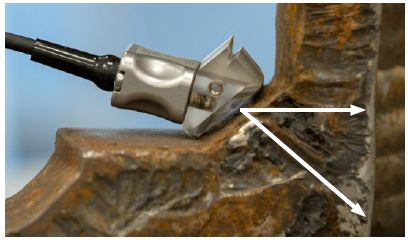
The two most common positions for placing the UT transducers are on the flange taper and between the bolt holes. As illustrated in the photographs below.

Taper areas of flanges are not always the same therefore geometry must be plotted for each flange. This step is difficult and can lead to error in condition assessment.

phased array transducer on the angled section of the flange.

This technique is performed by placing the phased array transducer on the angled section of the flange.

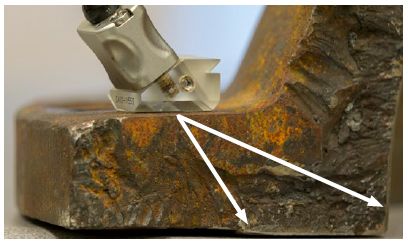
Due to design requirements and normal manufacturing process the location between the bolt holes is square to the flange face. This location is also consistent in distance therefore repeated applications can be compared. In some cases two bolts must be removed at each quadrant for the UT probe to fit properly. Removing the bolts is only done if the flange is offline and depressurized. If highly hazardous materials are contained by the subject flange then removal of bolts may not be allowed.

phased array transducer is applied between the bolts

With this technique the phased array transducer is applied between the bolts.

Raised Face Flange Photos

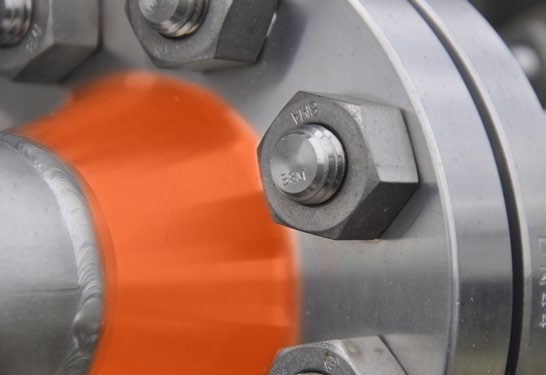
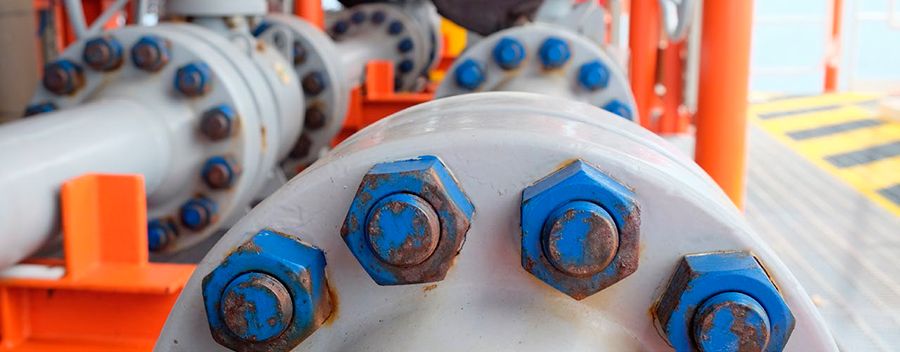
These photos are an example of raised face flanges as applicable to piping.

Raised Face Flange

Phased Array Transducer can be placed on the angled section of the flange

Raised Face Flange

Phased Array Transducer can be placed between the bolt holes

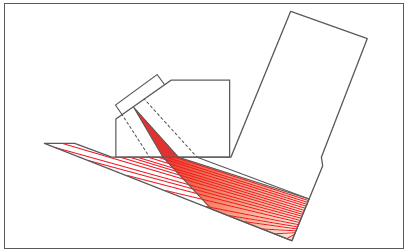
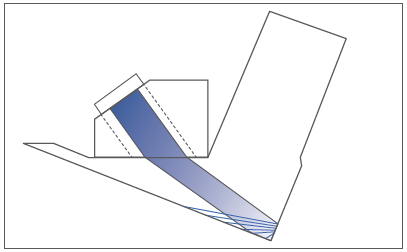
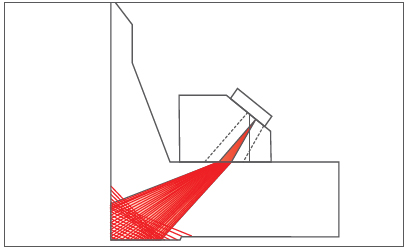
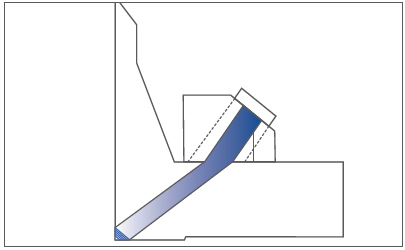
ES Beam Tool Image

Using the ES Beam Tool can help perform a setup phased array techniques

phased array set up technique using the ES Beam Tool

Phased array applied with the transducer on the flange taper.

Phased array applied with the transducer between the bolt holes.

Phased array applied with the transducer between the bolt holes.

Industry Applications

The primary focus for this application are manufacturers and/or users of Hydrofluoric Acid (HF). HF units are common in refineries and chemical plants. Other types of processes can attack the flange seal location including acids, steam and salt water.

Calibration Standard

A calibration standard should be used to confirm the phased array setup. Using a duplicate of the flange size and weight with targets manufactured in the raised face sealing area for UT performance demonstration is the ultimate confirmation of setup performance.

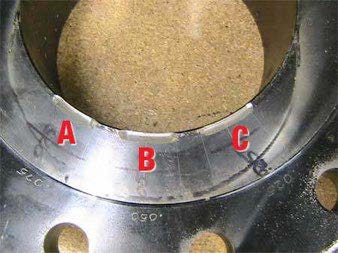
Example of calibration standard:

Flange Calibration Standard

A = .075 in. deep X 1.0" long
B = .050 in. deep X 1.0" long
C = .025 in. deep X 1.0" long

OmniScan testing flange

Applicable Olympus Products

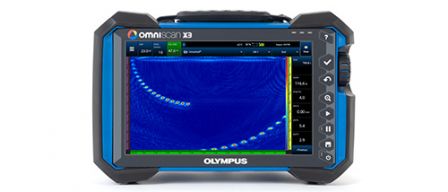
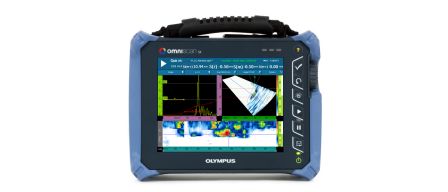
Examination of raised face flanges can be performed using the Epoch 1000, Omniscan MXU-M or Omniscan MX.

Our small Phased Array Probes are well suited for flanges with smaller distances between the bolts and nuts.

Industry has used single channel flaw detectors such as the Epoch XT with good success. The test is concluded with only numerical values illustrating loss of sealing area. No image is provided therefore only the inspectors word is left in writing.

Advantages

  • Condition assessment of the sealing area without separating the flanges
  • Cost savings to the owner/operator
  • Increased safety doe to the reduced potential for exposure to hazardous chemicals when separating the flanges
  • Inspection can be performed while the equipment is on-line
  • Planning for repair before TAR commences

Products used for this application

EPOCH 1000系列

EPOCH 1000是一款高级常规超声探伤仪,可在授权的Olympus服务中心为其升级,使其具有相控阵成像功能。其主要特性包括:符合EN12668-1标准、37个数字式接收器滤波器选择、用于高速扫查的6 kHz脉冲重复频率。

EPOCH XT

EPOCH XT是一款高级便携式超声探伤仪。具有很多标准测量功能,其中包括可调方波脉冲发生器、可选窄带和宽带数字式滤波器、0~110 dB的增益范围、峰值记忆和峰值保持、可调PRF。

OmniScan MX

OmniScan MX是一款使用多种技术的高级探伤仪。这款便携式模块化探伤仪具有极高的采集速率和强大的软件功能,可以进行高效地手动和自动检测。这款仪器可以使用PA和常规UT模块,以及常规EC和ECA模块。

OmniScan MXU-M

初级水平的OmniScan MXU-M解决方案将相控阵成像的优势引入了手动检测,同时保留了其经过实践证明的所有优势性能。这款仪器的性能包括:初级水平的相控阵模块(M系列)、手动UT缺陷检测、实时相控阵成像。

Inspection & Measurement Systems
English | 日本語 | français | 简体中文 | Deutsch | italiano | čeština | magyar | Tiểng Việt | Español | русский | polski | português | 한국어

Advanced NDT Solutions

Flaw Detectors

Integrated Inspection Systems