Aplicação
Testar a integridade de soldaduras por brasagem em tubos metálicos e outras peças.
CenárioA solda por brasagem é um processo comum para juntar seções de tubos de metal com diâmetro pequeno e algumas outras peças metálicas, como contatos elétricos. Ela une duas peças de metal com um enchimento de material metálico que é fundido e, em seguida, é vertido para dentro do espaço entre as peças por atração capilar. Este processo é semelhante à soldagem. O metal de enchimento, normalmente uma liga de cobre, prata, estanho e/ou zinco com ponto de fusão relativamente baixo, deve preencher o espaço entre as duas peças que serão unidas, umedecer as superfícies e, então, fundi-las ao esfriar e solidificar. Se a junta metálica não flui de maneira adequada ou não funde, a integridade da articulação é afetada. Este problema pode normalmente ser identificado com um detector de defeitos ultrassônico. |
|
Equipamento
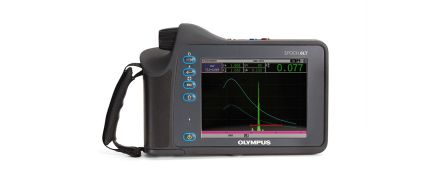
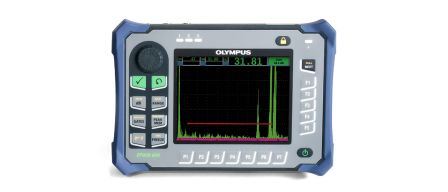
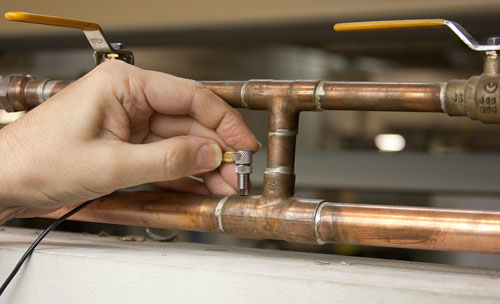
A maioria das juntas de solda podem ser testadas com os detectores de defeitos EPOCH® 6LT, EPOCH 650 ou EPOCH 1000, da Olympus. Dada a geometria comum das juntas das soldas, transdutores de linha de atraso ou de contato de pequeno diâmetro são geralmente utilizadas. O transdutor deve ser selecionado de acordo com a geometria da junta que será testada, mas os transdutores V208-RM de tubo de pequeno diâmetro (20 MHz) e o Sonopen® (15 MHz) são normalmente recomendados. Suportes com molas estão disponíveis para esses transdutores para ajudar no alinhamento.
Procedimento
Normalmente, as juntas das soldas são testadas usando um feixe linear que monitora a amplitude do eco a partir da localização da solda e da superfície interna da parte externa do metal. No caso de soldas por brasagem bem unidas ao ponto de ensaio, a liga metal-metal retornará uma reflexão pequena, enquanto uma lacuna no ponto do teste retornará uma reflexão muito maior. Esses níveis devem ser estabelecidos para cada caso específico através da definição de amostras que representam uma condição soldada e não soldada.
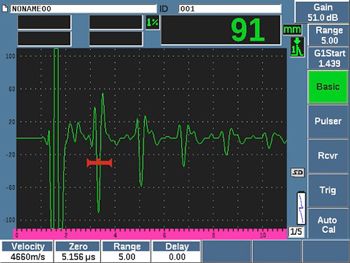
O exemplo abaixo mostra os ecos típicos a partir da junta da solda entre 9,5 mm e 12,5 mm de um tubo de cobre que foi testado com um transdutor de linha de atraso V208-RM e um detector de defeitos. A primeira forma de onda mostra um eco de referência de uma área não soldada de um tubo externo que foi marcado com uma porta e definido próxima à altura da tela. A segunda forma de onda mostra a resposta de uma junta devidamente soldada, na qual o eco da região fechada cai a um nível muito baixo e é seguida por um pico maior que representa o eco da parte interna da superfície do tubo interno. Ao observar a amplitude do eco dentro da porta, o operador pode determinar a condição da junta em cada ponto de teste ao comparar a amplitude do eco com os níveis de referência.
Uma soldagem parcial dentro da área do feixe de som, devido a condições como porosidade, será tipicamente representada por um eco de nível médio. Nota: é importante lembrar que descontinuidades muito pequenas, como orifícios que são uma pequena fração do diâmetro do feixe, não serão detectadas com esse procedimento.
Resposta de eco típica de uma junta soldada, com um eco mínimo na porta.
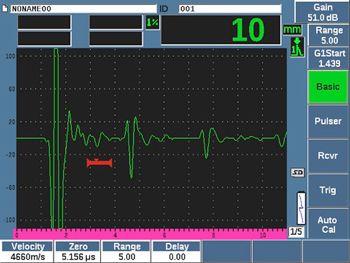
Resposta de eco típica de uma junta não soldada, com um eco grande na porta.