High Resolution & High Contrast
This specially designed module provides bright and high contrast deep ultraviolet real time images for detailed semiconductor and nano-fabrication inspections
The optical system optimized for 248 nm provides resolutions down to 80nm, two times better than that available with the visible light. The 248 ±4nm imaging band is corrected to prevent chromatic aberrations. This technique makes it possible to observe both high-contrast and high-resolution features without preprocessing. Common applications for DUV observation include detailed inspections of semiconductor patterns, gap and pole identification on magnetic heads, and microlithography.

Deep Ultraviolet Observation | 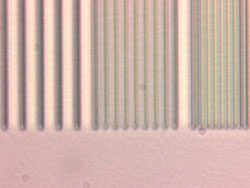
Visible Light Observation |
Newly designed robust DUV Objective Lens
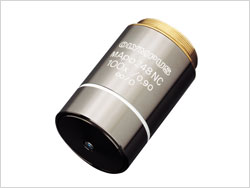
DUV Objective Lens |
The DUV lens is specially designed with a unique "non-cemented" technology to prevent deterioration found in other DUV lenses, making it an ideal solution for long-term use.
|
Modular Design
Increased Flexibility and Safety through an External Lamphouse
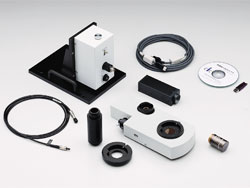
Deep Ultraviolet Observation Module |
The modularity of the DUV system not only allows for integration with the Olympus MX and BX series of microscopes, but allows the mercury-xenon power supply to be independent of the microscope and directs the illumination to the DUV module via a UV light guide. The shutter design employed protects the operator by directing the illumination to the DUV objective lens and camera only. In addition, since the light source is set apart from the microscope and the intensity can be
independently controlled to the optimum level, heat transition to the sample is minimized.
|
Real Time Imaging
The high resolution DUV digital camera is software controlled and capable of high-speed data acquisition. Images captured on the computer can be quickly documented and analyzed for easy storage in a database and report generation.
Economical and Efficient
Light Weight and Compact
The DUV intermediate tube is simple with no moving parts or external control; this allows the tube to be half the size and weight of conventional DUV microscope systems.
Efficient Mercury Xenon Lamp
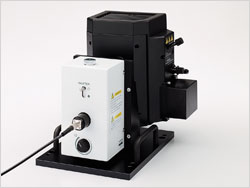
Lamphouse and Power Supply |
A long-life mercury xenon lamp is used to power the DUV module. Its average lifetime is >1000 hours, thus reducing operating costs and minimizing lamp replacements.
|
Back to top

