Inspection & Measurement Systems

应用

Application Notes

Measurement of wall thickness of steam boiler tubes with EMAT transducers

Recommended instruments:
Model 38DL PLUS thickness gage
Epoch XT, Epoch LTC, Epoch 1000, or EPOCH 600 flaw detector

Background: The very high temperatures found inside steam boilers (in excess of 1500 degrees Fahrenheit or 800 degrees Celsius) can cause the formation of a specific type of hard, brittle iron oxide called magnetite on the inside and outside surfaces of steel boiler tubing. The presence of this oxide layer on the outside of tubes can interfere with ultrasonic wall thickness measurement using common dual element transducers, both because it can have a very rough surface that prevents proper sound coupling, and because oxide thickness will be added to the steel thickness. However, as its name implies, magnetite is magnetic, and that property permits the use of magnetostrictive EMAT (Electomagnetic Acoustic Transducer) transducers such as the Panametrics-NDT E110-SB. EMATs offer several advantages over conventional dual element piezoelectric transducers: it is not necessary to remove oxide scale in order to make measurements, the scale thickness is not added into the wall thickness measurement, and measurements can be made very quickly and without need for liquid couplant. The primary limitation of magnetostructive EMATs is that they work only when scale is present and bonded to the outside of the boiler tube. Additionally, the minimum measurable wall thickness and measurement accuracy will not be nearly as good as what can be achieved with a conventional dual, and EMATs are relatively insensitive to small internal pits. For that reason, EMATs are often used for quick initial wall thickness surveys, while duals can then be used to take a closer look at areas of concern.

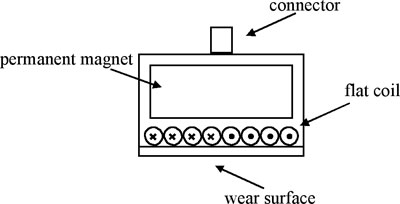
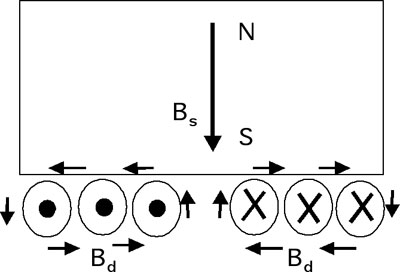
Theory of operation: There are two types of EMATs used within the NDT industry. One is known as a Lorentz EMAT, which does not require the presence of oxide scale, but does require very high driving power. A magnetostrictive EMAT such as the E110-SB requires scale but works at the much lower power levels typical of field portable ultrasonic gages and flaw detectors. It consists of a strong permanent magnet and a coil which acts as an electromagnet when driven by the excitation pulse from the test instrument, as seen in Figure 1. The permanent magnet creates a magnetic field perpendicular to the surface of the scale (Bs in the figure below), while the dynamic field created by the electromagnet (B d) causes the scale to be pulled radially outward and inward as the coil is pulsed, as seen in Figure 2. This motion generates a normal incidence shear wave in the scale, which then propagates into the steel. Essentially, the scale acts as the active transducer element to generate the sound pulse. The frequency of the sound pulse will vary as oxide thickness changes, increasing as oxide becomes thinner and decreasing as oxide becomes thicker. With typically thin scale buildups, the frequency will be approximately 5 MHz. The process also works in reverse to generate a voltage in the coil when the returning shear wave echo vibrates the scale.


Figure 1 -- Cross section of typical EMAT


Figure 2 -- Method of sound wave generation

Because the scale itself is the transducer element, scale roughness is not a coupling issue, and the scale is not added into the thickness measurement. The EMAT generates a shear wave, so the instrument must be calibrated to a shear wave velocity of approximately 0.1280 in/uS or 3,240 m/S in typical carbon steel. Typical measurement accuracy with the E110-SB EMAT transducer will be +/- 0.010 in. or 0.25 mm, with a minimum measurable thickness of at least 0.080 in. or 2.0 mm depending on material properties.

Setup and measurement procedures:As a general note, the quality of ultrasonic echoes in EMAT applications in part depends on the consistency of the oxide scale layer, which can vary from point to point on a given boiler tube. If usable echoes cannot be obtained at one point, try another point nearby. Also, the E110-SB transducer incorporates an adjustable standoff that varies the distance between the transducer face and the surface of the boiler tube. Adjusting this standoff distance will help optimize echo response in many cases.


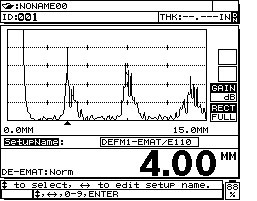
(a) Model 38DL PLUS gage: The E110-SB transducer is used with the Model 38DL PLUS thickness gage in conjunction with a 1/2XA/E110 adapter, which provides both probe recognition and added high pass filtering that is necessary for proper signal conditioning. When the adapter is plugged in, the gage will automatically select the EMAT default setup DEFM1-EMAT/E110. As with any gage setup, for optimum accuracy a two-point velocity/zero calibration should be performed on thick and thin reference standards of known thickness, but if such standards are not available the default settings will usually be sufficient as a starting point. Instrument gain and echo blanking may be adjusted as necessary to optimize echo detection. Under the EMAT default setup, the 38DL PLUS will display a full wave rectified waveform. A typical waveform display is seen below in Figure 3.


Figure 3 -- Typical rectified EMAT waveform
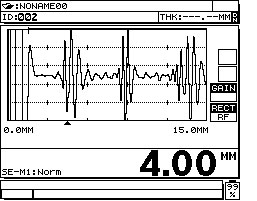
For a more detailed look at the shape of the waveform, which can be useful under challenging measurement conditions, select the RF display more from the gage setup menu. A typical RF waveform from an EMAT measurement is seen in Figure 4.


Figure 4 -- Typical RF EMAT waveform


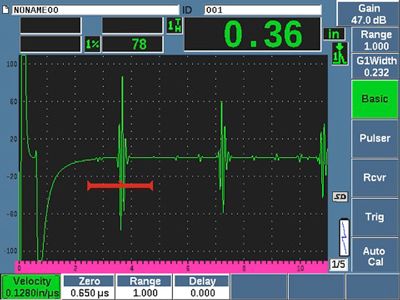
(b) EPOCH XT, EPOCH LTC, EPOCH 1000, or EPOCH 600: A typical EMAT starting setup and waveform for an Epoch series flaw detector is seen in Figure 5. Note that bandpass filtering must always be used to filter out low frequency noise associated with EMATs. Also, because shear wave frequency varies with oxide scale thickness, the Epoch's square wave frequency should be adjusted as necessary for optimum echo response.


Figure 5 -- Typical Epoch waveform and setup

Products used for this application

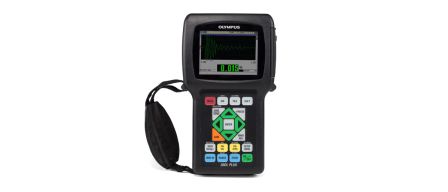
38DL PLUS

38DL PLUS是一款高级超声测厚仪。这款仪器可使用双晶探头对内部腐蚀的部件进行检测。其性能包含THRU-COAT®(穿透涂层)和回波到回波。还可以使用单晶探头对薄材料、极厚材料以及多层材料进行非常精确的厚度测量。

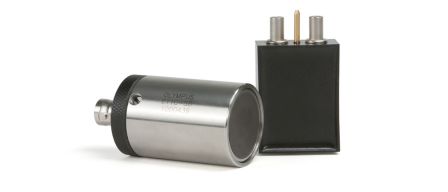
EMAT探头

这些EMAT单晶探头使用磁致伸缩效应发送和接收超声波。

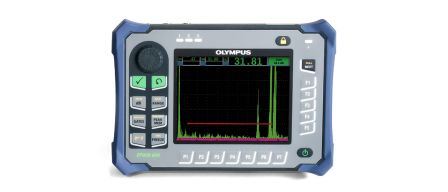
EPOCH 1000系列

EPOCH 1000是一款高级常规超声探伤仪,可在授权的Olympus服务中心为其升级,使其具有相控阵成像功能。其主要特性包括:符合EN12668-1标准、37个数字式接收器滤波器选择、用于高速扫查的6 kHz脉冲重复频率。

EPOCH 600NEW

EPOCH 600是一款中级水平的手持式超声探伤仪。EPOCH 600仅重1.68公斤(3.72磅),机身横宽竖窄,机壳坚固耐用,可以在非常恶劣的检测环境中正常工作。EN12668-1型号仪器增加了400 V PerfectSquare可调方波脉冲发生器及用于加强信噪比的数字式滤波性能。

EPOCH LTC

EPOCH LTC是一款中级水平的手持式超声探伤仪。这款小巧的仪器为横窄竖宽结构,仅重0.96公斤(2.12磅)。这款功能齐全的仪器符合EN12668-1标准,不仅具有各种标准的功能,还可附加满足用户的具体检测需求的特殊选项。

EPOCH XT

EPOCH XT是一款高级便携式超声探伤仪。具有很多标准测量功能,其中包括可调方波脉冲发生器、可选窄带和宽带数字式滤波器、0~110 dB的增益范围、峰值记忆和峰值保持、可调PRF。

English | 日本語 | français | 简体中文 | Deutsch | italiano | čeština | magyar | Tiểng Việt | Español | русский | polski | português | 한국어