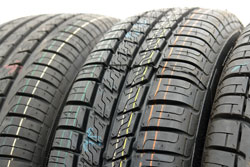
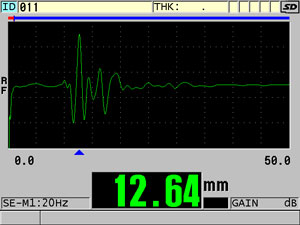
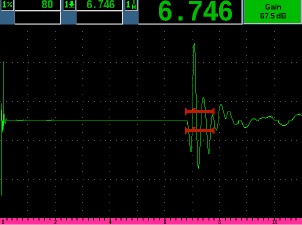
 ApplicationMeasuring the depth of steel and fiber ply cords or belting in all types of rubber tires and, in many cases, total wall thickness as well. BackgroundFor quality control purposes, manufacturers of rubber tires need to know the position of the steel or fiber ply cords that are embedded in the walls of automobile, truck, and off-road vehicle tires. This is particularly important in the case of the large, expensive tires used for heavy trucks and construction equipment, where improper cord positioning can lead to costly failures. In some cases, manufacturers also want to measure total wall thickness. Because rubber is very attenuating to high-frequency sound waves, and because of the complex pattern of echoes that are generated by the internal structure of most tires, these measurements require special consideration. EquipmentThere are two common approaches to rubber tire measurement, depending on the thickness of the tires to be measured. Olympus recommends the following instruments for specific applications: Procedure for useSound attenuation and internal structure vary widely between various types of tires, so it is important to evaluate each application individually. The measurement of rubber always requires low-frequency transducers of 2.25 MHz or lower. In some cases, it is advantageous to use a transducer with an epoxy wear surface to improve sound coupling between the transducer and the rubber. The most commonly recommended transducers for tire testing are the Olympus M1036 (2.25 MHz, 12.5 mm [0.5 in.] diameter, high penetration) and the V601-RB (500 kHz, 25 mm [1 in.] diameter). In applications involving very thick tires (greater than 4 in. or 100 mm of rubber), pairs of V601-RB transducers have been successfully used in pitch-catch mode with a flaw detector. Separating the transmitter and receiver functions allows the use of very high receiver gain without the potential noise problems associated with amplifying the excitation pulse recovery. Gel couplant is normally recommended for all rubber tire applications. To help ensure good wetting, the couplant must be worked into the surface. As with any ultrasonic thickness measurement, it is necessary to calibrate the sound velocity of the rubber in question using a sample of known thickness. The velocity of rubber changes rapidly with temperature, so for best accuracy, the sound velocity must be measured at a temperature that closely corresponds to actual measurement conditions. Successful ultrasonic measurement of total tire thickness—as opposed to the depth of the ply cords—depends on the structure of the ply cords. In some types of tires where there are many layers of ply cords and/or the ply cords are very close together, not enough sound energy will reach the inside wall to permit measurement of the total thickness. In other tires where there is more separation between the individual ply cords, some sound energy will get through to the inside wall and measurement of total thickness will be possible. This must be evaluated on a case-by-case basis. In cases where an inside wall echo is visible, the instrument can be switched to a second stored setup that can be used to make the measurement. Figure 1 shows the echo from steel ply cords, measured from the outside tread, in an automobile tire whose tread is approximately 12.5 mm (0.5 in.) thick. It is measured here with the model 38DL PLUS gage and an M1036 transducer (2.25 MHz). In this case, the echo is measured to the first positive lobe.
Figure 1
Figure 2 |


Rozwiązania dla przemysłu
Resources
Application Notes
Back to Resources
Measuring the Thickness of Rubber Tires

ProductsUsedApplications
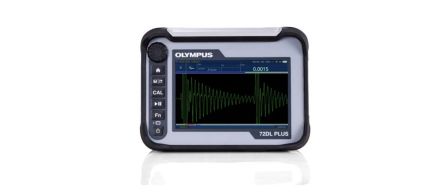
The 72DL PLUS™ advanced ultrasonic thickness gauge delivers precision thickness measurements at high speed in a portable, easy-to-use device. Compatible with single element transducers up to 125 MHz, this innovative instrument is ideally suited to measure the thickness of ultra-thin materials, including multilayer paint, coatings, and plastic. It can simultaneously display the thickness of up to 6 layers.
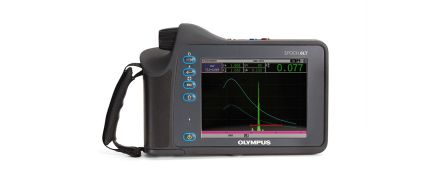
The EPOCH 6LT portable ultrasonic flaw detector is optimized for one-handed operation and delivers excellent performance in rope access and high-portability applications. Lightweight with an ergonomic design, the instrument fits securely in a user’s hand or can be strapped to the leg for rope access applications.
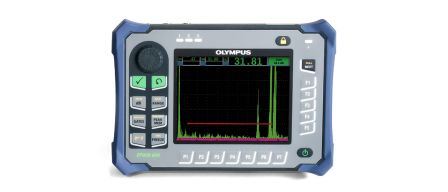
The EPOCH 650 is a conventional ultrasonic flaw detector with excellent inspection performance and usability for a wide variety of applications. This intuitive, rugged instrument is a continuation of the popular EPOCH 600 flaw detector with additional capabilities.
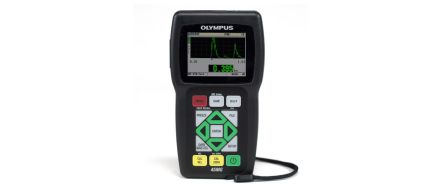
Zaawansowany grubościomierz ultradźwiękowy 45MG dostępny jest ze standardowymi funkcjami pomiarowymi oraz z opcjami oprogramowania. Ten unikalny przyrząd jest kompatybilny z całą gamą głowic jedno- i dwuprzetwornikowych do pomiaru grubości firmy Olympus.
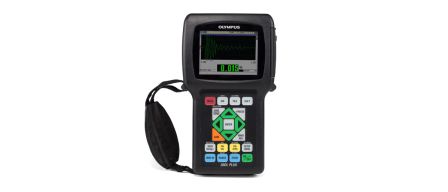
Wszechstronnego grubościomierza 38DL PLUS™ można używać z głowicami dwuprzetwornikowymi do wykonywania pomiarów skorodowanych rur oraz z głowicami jednoprzetwornikowymi do wykonywania bardzo precyzyjnych pomiarów grubości cienkich lub wielowarstwowych materiałów.
Sorry, this page is not available in your country
Let us know what you're looking for by filling out the form below.