응용분야

Application Notes

Ultrasonic Testing in the Foundry Industry

Foundry sceneApplication: This note contains a general overview of ultrasonic nondestructive testing applications in the foundry industry, including thickness gaging, flaw detection, and nodularity testing.

Background: The art of casting metal into specific shapes goes back thousands of years, but it is only in recent decades that modern ultrasonic NDT tools have been available to help insure product integrity. In ancient times, a foundryman might tap a casting with a hammer to judge its quality by the sound of the ring. Today, microprocessor-based instruments that also utilize sound waves can provide much more information about the hidden internal structure of both ferrous and nonferrous castings. Ultrasonic thickness gages can be used to measure the wall dimensions of hollow castings, ultrasonic flaw detectors can be used to identify discontinuities like hidden porosity, inclusions, voids, and cracks, and velocity-based testing can be used to quantify graphite nodularity in cast iron.

(a) Ultrasonic Thickness Gaging
Ultrasonic thickness gaging is of greatest use in the case of hollow castings with complex shapes, like automobile engine blocks, where core shifts during the casting process can result in a part that is too thin on one side and too thick on the other. An ultrasonic gage can measure wall thickness from one side, with no need to cut the part for access.

Equipment: This test is normally performed with one of the Panametrics-NDT precision gages (Models 35, 35DL, or 38DL PLUS). If metal thickness exceeds approximately 0.5 in. or 12.5 mm, the high penetration versions of these instruments (Models 35HP, 35DLHP, or 38DL PLUS with HP option) should be used. Transducer selection will depend on the range of thickness to be measured and the acoustic properties of the specific cast metal. The most commonly used transducers are the M106, M1036 (both 2.25 MHz), M109, and M110 (both 5 MHz). For very thick castings (over approximately 2 in. or 50 mm), a large diameter, low frequency transducer like the 500 KHz M101 is often recommended.

Procedure: Detailed gage setup and calibration procedures can be found in the operating manual for each instrument. The following additional notes relate to measurement of castings:

Couplant: The rough surfaces typically found on sand castings will impair transducer coupling, so a high viscosity couplant such as gel (Couplant D) or glycerin (Couplant B) should always be used.

Surface Condition: If the coupling surface is very rough, the minimum thickness that can be measured with a given transducer will be increased because of sound reverberations in the couplant layer that must be blanked out. Likewise, the maximum measurable thickness will be reduced because of inefficient sound coupling between the transducer and the casting. While in most cases thickness measurements can be made on as-cast surfaces, in challenging applications surface preparation will improve performance.

Geometry: The inside and outside surfaces of a casting must be approximately parallel or concentric to permit ultrasonic gaging. If the walls are severely misaligned with respect to one another, sound waves will be reflected away from the transducer and no echo will be seen.

Velocity Variations: Any ultrasonic thickness measurement will be accurate only to the degree that material sound velocity is consistent with gage calibration. Sound velocity can vary in both ferrous and nonferrous castings due to changes in hardness and grain structure, and also due to changes in graphite nodularity in the case of cast iron. In the case of large castings where different areas cool at different rates, velocity may change within a single part due to the non-uniform grain structure. For optimum measurement accuracy, gage velocity calibration should always be performed on a reference standard of known thickness that is metallurgically similar to the parts being tested.

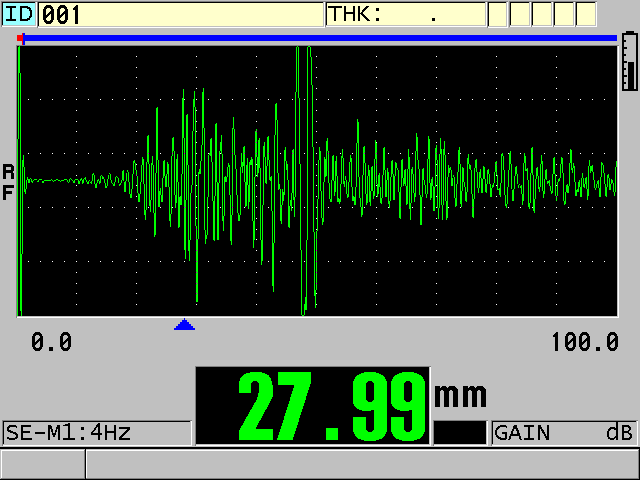
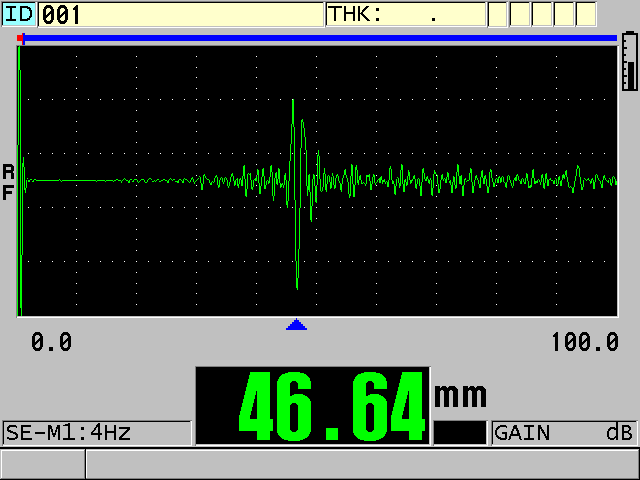
Scatter Noise: The coarse grain structure of some cast metals produces internal scatter noise ahead of the backwall echo that can cause a gage to hang up on false readings, especially when using gage default setups rather than customized setups. This condition can be readily diagnosed by observing the waveform. Noise hangups can usually be eliminated by simple adjustments to instrument gain and/or blanking, or by switching to a lower frequency transducer. For an example, see the waveforms in
Figures 1 and 2.

Scatter noise causing false reading. Backwall echo is at right of screen.
Figure 1 - Scatter noise causing false reading. Backwall echo is at right of screen.

Correct thickness reading after adjustment of initial gain and TDG Slope.
Figure 2 - Correct thickness reading after adjustment of initial gain and TDG Slope.

(b) Ultrasonic Flaw Detection
In the course of the casting process, a variety of internal discontinuities can occur in the metal. These include voids, porosity, inclusions, and cracks. All of these conditions produce ultrasonic indications that can be identified by a trained operator using an ultrasonic flaw detector with appropriate transducers.

Equipment: Any of the Panametrics-NDT Epoch series flaw detectors (Epoch XT, Epoch LTC,, Epoch 600, and Epoch 1000) can be used for casting inspection. Dual element transducers such as the DHC series, in frequencies between 1 MHz and 5 MHz, are commonly used when testing castings, both to reduce reflections from couplant trapped in rough cast surfaces and to optimize reflections from irregularly shaped discontinuities. In some cases, angle beam transducers may be used for crack detection. Specialized test systems that perform automated scanning will use immersion transducers in the same frequency range.

Procedure: The granular nature of both ferrous and nonferrous castings presents a challenge to ultrasonic flaw detection because of the reflections generated by grain boundaries, with the amount of grain scatter noise increasing as grain size increases. Additionally, as in thickness gaging applications, the rough surface typically found on sand castings impair sound coupling and reduces echo amplitude. These factors will determine the minimum detectable defect size in any given test. For this reason, it is important to pay careful attention to transducer selection and instrument setup. The recommended procedure is to optimize transducer selection and setup with the aid of reference standards representing samples of the parts to be inspected that contain known defects that have been identified by destructive testing, radiography, or other non-ultrasonic techniques. The indications from these known defects may then be stored and compared with indications from test pieces. Bandpass filtering as found in the Epoch XT, Epoch LTC, and Epoch 1000 is very helpful in reducing grain scatter noise.

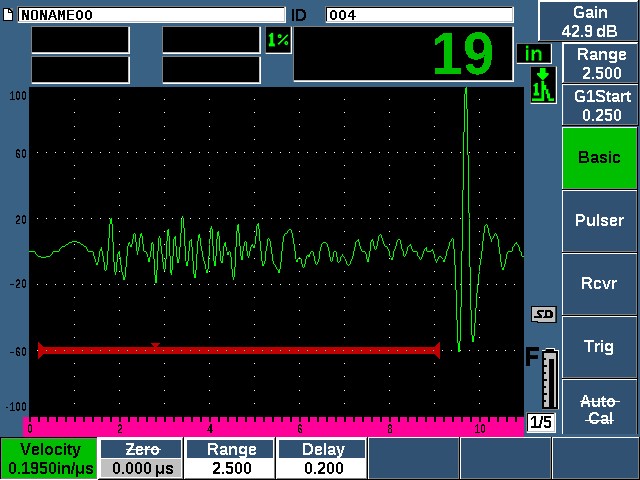
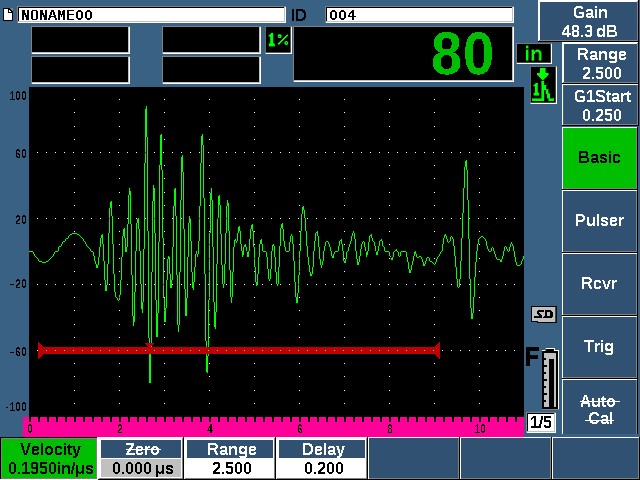
Figures 3 and 4 show a typical test for porosity in a 40 mm (1.6 in.) iron casting, using an Epoch XT with a DHC709-RM (5 MHz, 0.5 in. diameter) dual element transducer. Figure 3 shows the backwall echo from the casting at the right side of the screen, along with typical low-level surface noise and grain noise along the baseline. Figure 4 shows an indication from a void defect, which is readily identifiable against the background noise.

Good Casting Aea
Figure 3 - good area of casting

Porosity Indication
Figure 4 - porosity indication

While the most common flaw detection application in castings involves voids, porosity, and inclusions, some users also need to check for cracking or fractures. Crack tests must always be developed with respect to the specific geometry of the casting, and the location, size, and orientation of suspected cracks, utilizing appropriate reference standards containing known or artificially induced defects. Straight beam transducers are used when the crack face is parallel to the transducer coupling surface, and angle beams are used when the crack is perpendicular or tilted with respect to the coupling surface. Note that because of the lower sound velocity in cast iron and nonferrous castings, the actual refracted angles of wedges designed for use on steel will be lower. These angles should be recalculated by means of Snell's Law whenever conventional steel wedges are used on other materials.

(c) Nodularity Testing
The size and distribution of graphite inclusions in cast iron, known as nodularity, has a major effect on the iron's mechanical strength. Testing for nodularity is especially important in the automotive industry and other fields where cast iron is used for safety-critical components. Ultrasonic techniques offer a nondestructive alternative to microscopic cross-sectional examination and tensile strength tests for determining the degree of nodularity, because nodularity can be correlated to sound velocity.

The recommended instruments for nodularity testing are the Model 35HP, or the Model 38DL PLUS thickness gage, both of which can provide a direct readout of sound velocity. It is also possible to use any other Panametrics thickness gage or an Epoch series flaw detector and obtain velocity information via a velocity calibration procedure. This important subject is discussed in detail in the Application Note " Measuring Nodularity in Cast Iron". Please refer to that document for further detailed information regarding equipment and procedure.

The Olympus NDT Applications Lab is available to provide assistance with transducer selection and instrument setup for this or any other ultrasonic test application.

Products used for this application

35

The pocket-sized 35 is a handheld ultrasonic thickness gage for precision measurements on metal, plastic, rubber, glass, and composites using single element transducers. Wide thickness range from 0.08 mm to 635.0 mm (0.0030 in. to 25.0 in.) Optional live Waveform and Adjust Mode.

35DL

The pocket-sized 35DL is a handheld ultrasonic thickness gage for precision measurements on metal, plastic, rubber, glass, and composites using single element transducers. Same features as Model 35 but has internal datalogger.

38DL PLUS

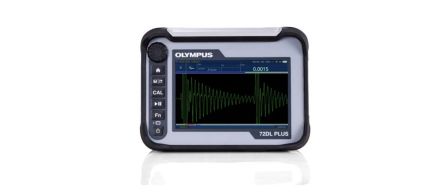
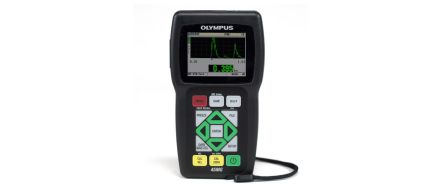
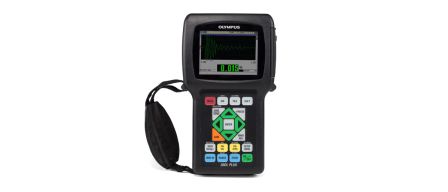
The 38DL PLUS is an advanced ultrasonic thickness gage. Uses dual element transducer for internally corroded applications, features include THRU-COAT and Echo-to-Echo. Uses single element transducers for very precise thickness measurements of thin, very thick, or multilayer materials.

EPOCH 1000 Series

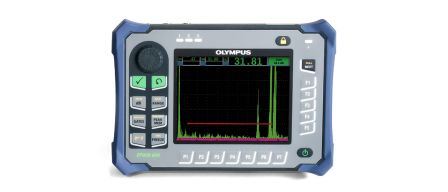
The EPOCH 1000 is an advanced conventional ultrasonic flaw detector that can be upgraded with phased array imaging at an authorized Olympus service center. Key features include: EN12668-1 compliant, 37 digital receiver filter selections, and 6 kHz pulse repetition rate for high speed scanning.

EPOCH LT

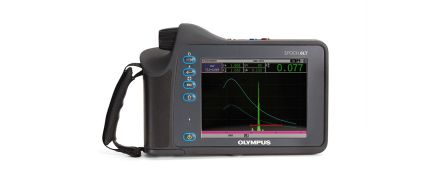
The EPOCH LT is a basic, handheld digital flaw detector, 38 mm (1.5 in.) thick and packed in a 1 kg (2.35 lbs) vertical package gives fast display update rate at a minimum 60 Hz, automated transducer calibration, a numeric datalogger, and many other measurement features.

EPOCH LTC

The EPOCH LTC is a mid-level, handheld ultrasonic flaw detector in a compact 2.12 lbs (0.96 kg) vertical case. It is a full-featured instrument with EN12668-1 compliance and a wide variety of standard features as well as specialized options to meet your inspection needs.

EPOCH XT

The EPOCH XT is an advanced, portable ultrasonic flaw detector offering many standard measurement features including a tunable square wave pulser, selectable narrow-band and broad-band digital filters, gain range from 0 to 110 dB, peak memory and peak hold, and adjustable PRF.

Inspection & Measurement Systems
English | 日本語 | français | 简体中文 | Deutsch | italiano | čeština | magyar | Tiểng Việt | Español | русский | polski | português | 한국어

고급 NDT솔루션

Flaw Detectors

통합 검사 시스템