| Cette note d’application explique comment mesurer les modules d’élasticité à l’aide d’appareils de recherche de défauts et de mesure d’épaisseur. Lisez cette note d’application pour en savoir plus sur la façon de mesurer le module d’élasticité de Young, le module de cisaillement et le coefficient de Poisson dans les matériaux industriels isotropes non dispersifs. Comprendre le module d’élasticité de YoungLe module d’élasticité de Young se définit comme le rapport entre la contrainte (force par unité de surface) et la déformation correspondante (déformation) dans un matériau sous tension ou compression. Le module de cisaillement est semblable au rapport entre la contrainte et la déformation mentionné ci-dessus, mais dans un matériau soumis à une contrainte de cisaillement. Le coefficient de Poisson est le rapport entre la déformation transversale et la déformation axiale correspondante sur un matériau soumis à une contrainte le long d’un axe. |
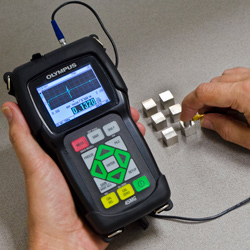
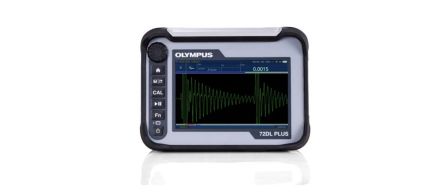
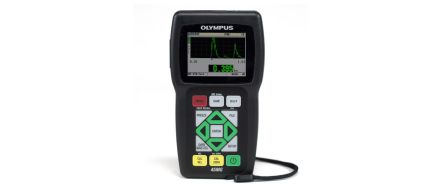
Ces propriétés de base des matériaux, qui sont utilisées dans de nombreuses applications de fabrication et de recherche, peuvent être déterminées par des calculs basés sur les vitesses de propagation des ondes sonores mesurées et sur la densité des matériaux. La vitesse de propagation des ondes sonores peut être facilement mesurée par l’application de techniques par écho d’impulsion au moyen de l’équipement approprié. La procédure générale décrite ci-dessous fonctionne pour tout matériau homogène, isotrope et non dispersif (la vitesse de propagation ne change pas avec la fréquence). Cela comprend la plupart des métaux courants, les céramiques industrielles et les verres dans la mesure où les dimensions de la coupe transversale ne s’approchent pas de la longueur d’onde de la fréquence d’inspection. Il est aussi possible de mesurer des plastiques rigides, comme le polystyrène et l’acrylique, mais il est plus complexe de le faire en raison de leur atténuation acoustique élevée. Le caoutchouc ne peut pas être caractérisé à l’aide de techniques par ultrasons en raison de sa grande dispersion et de ses propriétés élastiques non linéaires. De même, les plastiques souples présentent une très forte atténuation en mode d’inspection par ondes transversales et ne peuvent donc généralement pas être inspectés. En ce qui concerne les matériaux anisotropes, leurs propriétés élastiques varient en fonction de la direction, tout comme la vitesse de propagation des ondes transversales et longitudinales. La génération d’une matrice complète de modules d’élasticité dans des spécimens anisotropes nécessite généralement six ensembles différents de mesures ultrasonores. La porosité ou la granularité grossière d’un matériau peut influencer la précision des mesures ultrasonores des modules, puisqu’indépendamment de l’élasticité du matériau, ces conditions peuvent entraîner des variations de la vitesse de propagation des ondes sonores basées sur la taille et l’orientation des grains ou sur l’importance et la distribution de la porosité. Équipement d’inspection nécessaire pour le calcul des modulesLes mesures de vitesses de propagation des ondes sonores pour le calcul des modules sont souvent prises à l’aide de mesureurs d’épaisseur de précision, comme le 38DL PLUS™ ou le 45MG avec option logicielle pour sonde monoélément, ou bien à l’aide d’appareils de recherche de défauts comme l’EPOCH™ 650 ou l’EPOCH 6LT. On peut aussi utiliser le mesureur d’épaisseur 72DL PLUS™, qui offre une résolution supérieure pour les mesures de temps de vol et qui donne donc lieu à des mesures de vitesses de propagation plus précises. Ce type d’inspection requiert aussi l’utilisation de deux sondes adaptées au matériau inspecté, lesquelles serviront à mesurer la vitesse de propagation par écho d’impulsion en modes longitudinal et transversal. Généralement, on utilise une sonde à ondes longitudinales à large bande de type M12 ou V112 (10 MHz) et une sonde à ondes transversales d’incidence normale de type V156 (5 MHz). Ces sondes fonctionnent bien pour beaucoup de métaux et de céramiques cuites. Il faudra utiliser d’autres sondes pour les matériaux très épais, très minces ou à forte atténuation. Certaines applications peuvent également nécessiter l’utilisation de techniques de transmission directe au moyen de paires de sondes placées sur les côtés opposés de la pièce. Contactez-nous pour obtenir des recommandations spécifiques sur les sondes et une assistance pour la configuration de votre appareil. La forme de la pièce inspectée importe peu, tant qu’elle permet la mesure nette par écho d’impulsion du temps de parcours du son au travers de l’épaisseur d’une section. La pièce devrait idéalement avoir au moins 12,5 mm (0,5 po) d’épaisseur, des surfaces parallèles lisses et une largeur ou un diamètre supérieurs à ceux de la sonde utilisée. Faites preuve de prudence lors de l’inspection de pièces étroites en raison des possibles effets de bord qui peuvent influencer la mesure du temps de parcours des impulsions. La résolution sera limitée lors de l’utilisation de pièces très minces en raison des faibles variations qui surviennent dans le temps de parcours des impulsions le long des parcours sonores courts. C’est pourquoi on recommande d’utiliser des pièces d’au moins 5 mm (0,2 po) d’épaisseur, mais idéalement plus épaisses. Dans tous les cas, il faut connaître précisément l’épaisseur de la pièce. Procédure de calcul des modules d’élasticité à l’aide d’appareils de recherche de défauts et de mesure d’épaisseurMesurez la vitesse de propagation des ondes transversales et longitudinales dans la pièce à l’aide des sondes et de l’appareil appropriés. La mesure des ondes transversales nécessite l’utilisation d’un couplant spécial à haut coefficient de viscosité, par exemple le SWC-2. Le mesureur d’épaisseur 38DL PLUS ou le mesureur d’épaisseur 45MG avec option logicielle pour sonde monoélément peuvent fournir une lecture directe de la vitesse de propagation des ondes sonores dans le matériau en fonction d’une épaisseur d’échantillon saisie. Un appareil de recherche de défauts de la série EPOCH peut mesurer la vitesse de propagation grâce à une procédure d’étalonnage de la vitesse. Dans les deux cas, pour mesurer la vitesse de propagation, suivez la procédure indiquée dans le manuel de l’utilisateur de l’appareil. Il vous suffit d’enregistrer le temps de parcours aller-retour à travers une zone d’épaisseur connue à l’aide de sondes d’ondes transversales et longitudinales, et puis de faire le calcul suivant :
Pour des mesures de vitesses de propagation de haute précision, l’utilisation du mesureur d’épaisseur à ultrasons 72DL PLUS (+ ou – 10 picosecondes) est recommandée. Au besoin, convertissez les unités pour obtenir des vitesses exprimées en pouces par seconde ou en centimètres par seconde (le temps est généralement mesuré en microsecondes, multipliez donc les valeurs en po/μs ou cm/μs par 106 pour obtenir des valeurs en po/s ou cm/s). Les valeurs obtenues peuvent ensuite être intégrées aux équations ci-dessous :
Remarque sur les unités de mesure : Si la vitesse de propagation est exprimée en cm/s et que la densité est exprimée en g/cm3, alors le module de Young sera exprimé en dynes/cm2. Si vous utilisez les unités de mesure anglaise (po/s ou lb/po3) pour calculer le module en livre par pouce carré (PSI), n’oubliez pas la distinction entre la livre comme unité de force et la livre comme unité de masse. Comme un module s’exprime en force par unité de surface, si vous calculez en mesures anglaises, il faut multiplier la solution de l’équation ci-dessus par une constante de conversion masse/force égale à (1/accélération de gravité) pour calculer le module en livre par pouce carré (PSI). Sinon, si le calcul initial est effectué en unités métriques, il faut utiliser le facteur de conversion suivant : 1 PSI = 6,89 × 10⁴ dynes/cm2. Il est aussi possible d’intégrer la vitesse en po/s, la densité en g/cm3, puis de diviser le résultat par une constante de conversion égale à 1,07 × 10⁴ pour obtenir un calcul du module en PSI.
Pour un module de cisaillement, il suffit de multiplier le carré de la vitesse de propagation des ondes transversales par la densité. Encore une fois, utilisez les cm/s et les g/cm3 pour exprimer le module en dynes/cm2, ou alors les unités anglaises (po/s et lb/po3) dont vous multipliez le résultat par une constante de conversion masse/force. RéférencesPour en savoir plus sur la mesure par ultrasons des modules d’élasticité, veuillez consulter les documents suivants :
|