En esta nota de aplicación se explica cómo medir el grado de nodularidad en el hierro de fundición y cómo distinguir el hierro nodular del hierro gris. Conozca el equipamiento de inspección ultrasónico y las técnicas usadas para verificar la nodularidad de forma no destructiva en el hierro de fundición.
Producción de hierro fundido
El carbono en forma de grafito es usado por lo general como un aditivo en la producción de hierro fundido (o hierro de fundición), alcanzando del 2 % al 4 % en peso, o del 6 % al 10 % en volumen, en las fundiciones típicas. La microestructura del grafito en el hierro fundido presenta mayores efectos en la propiedades mecánicas de fundición. Cuando el grafito cambia a escamas delgadas da como resultado el hierro gris, que es duro y frágil. Cuando el grafito toma una forma de nódulo esférico da como resultado el hierro nodular, que es dúctil y maleable.
Tanto el hierro gris como el nodular son fabricados mediante una mezcla de carbono, dióxido de silicio y otros aditivos en el hierro de fundición. A menudo, parte de esta mezcla se efectúa en el molde final. Si la mezcla no es uniforme o el proceso de fundición presenta otras imperfecciones, la fundición podría sufrir variaciones en la nodularidad o mantener agujeros de hierro gris dentro de una fundición de hierro nodular. Estas variaciones cambiarán significativamente las propiedades mecánicas del metal; por lo tanto, las fundiciones necesitan verificar el hierro nodular para asegurar su homogeneidad. Es importante que la distribución del grafito en la fundición sea uniforme, y que las inclusiones de grafito mantengan la forma correcta (nódulos en lugar de escamas).
El examen microscópico y los ensayos de fuerza tensil son métodos efectivos para verificar la nodularidad. Otra opción son los ensayos ultrasónicos, que pueden medir las distintas velocidades acústicas del hierro nodular y el gris. Se prefiere este último método, ya que proporciona una evaluación rápida y no destructiva de la fundición.
Instrumento de inspección ultrasónica para ensayos de nodularidad no destructivos en hierro fundido
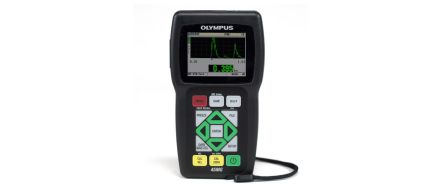
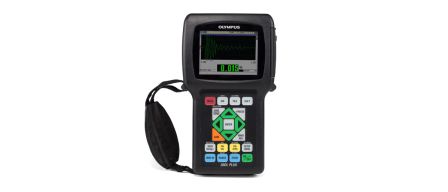
Los ensayos de nodularidad no destructivos pueden llevarse a cabo con cualquier instrumento ultrasónico que pueda medir la velocidad acústica, como los medidores de espesores, los detectores de defectos y los dispositivos de emisión-recepción. Para medir de forma específica la velocidad acústica, todos los medidores de espesores de alta precisión de Olympus brindan una lectura directa de la velocidad acústica en el hierro fundido y en otros materiales según la calibración de espesor determinada. Entre ellos destacan el medidor 38DL PLUS™ y el medidor 45MG dotado de la opción de software Sonda monoelemento. Para espesores superiores a 25 mm (1 pulg.) aproximadamente, siempre se recomienda usar la opción de software de Alta penetración con estos medidores.
Para llevar a cabo un ensayo de nodularidad con un medidor de espesores, simplemente pulse una tecla e ingrese los datos de espesor. La velocidad acústica se calcula automáticamente a partir del valor de espesor ingresado y el tiempo de propagación del impulso medido. Use la función de alarma alta/baja para detectar condiciones fuera de tolerancia. Sincronice el medidor con una sonda apropiada para el rango de espesor que va a medirse. Una opción común es una sonda de contacto M1036 de 2,25 MHz. La precisión en la medición de la velocidad de propagación acústica generalmente se encuentra alrededor del 0,1 %.
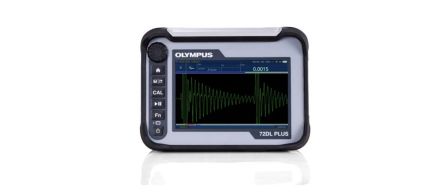
El medidor 72DL PLUS™ ofrece una pantalla táctil más grande y una frecuencia de refresco de medición superior (hasta 2 KHz) a los medidores 38DL PLUS y 45MG. Este medidor de espesores de precisión también otorga una resolución de medición del tiempo más alta, lo que conlleva a cálculos más precisos de la velocidad acústica. Además, el medidor 72DL PLUS brinda una mayor conectividad a través de opciones de comunicación inalámbrica y por cable, lo que es ideal para la integración del sistema.
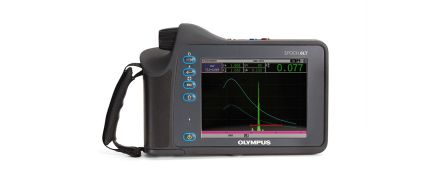
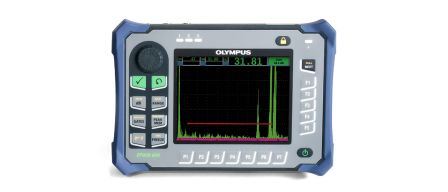
Cualquier detector de defectos EPOCH™, como las unidades EPOCH 650 y EPOCH 6LT, pueden usarse de manera similar para medir una velocidad desconocida. Con el detector de defectos calibrado para una sonda apropiada de baja frecuencia, se obtiene un eco de fondo a partir de la sección del espesor conocido y se efectúa la calibración de la velocidad acústica del material basada en los ecos detectados.
Procedimiento de ensayo ultrasónico para medir la nodularidad en hierro fundido
Existe una diferencia similar en la velocidad de propagación acústica entre el hierro puro, el hierro de fundición nodular y el hierro de fundición gris. Comúnmente, el hierro puro presenta una velocidad acústica aproximada de 5,9 mm/µS (0,232 pulg./µS), el hierro nodular de 5,6 mm/µS (0,222 pulg./µS), y el hierro gris de 4,8 mm/µS (0,192 pulg/µS). Las velocidades acústicas exactas para una determinada aplicación varían según la composición de la aleación, la estructura granular y otras variables del procesamiento. Cerciórese siempre de las velocidades exactas según los estándares de calibración específicos para el material bajo ensayo.
Se recomienda establecer un diagrama propio que contenga la velocidad en función del porcentaje de nodularidad para cada una de sus aplicaciones. Las investigaciones publicadas establecen una relación no lineal entre la velocidad acústica y el porcentaje de nodularidad 1. Sin embargo, es posible llegar a una diferencia sustancial con respecto a la velocidad acústica entre dos fundiciones idénticas que contengan el mismo porcentaje de grafito: una con el grafito en forma de escamas (hierro gris), y la otra con el grafito esférico (hierro nodular).
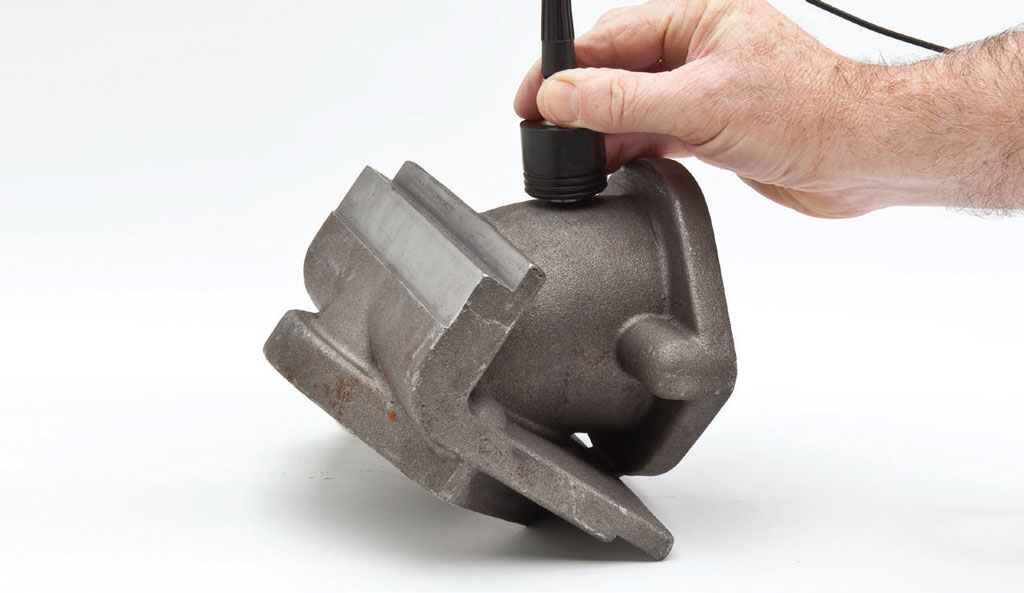
Tenga en cuenta que para medir la velocidad de propagación acústica, se requiere conocer el espesor de la pieza bajo ensayo. Por lo general, los inspectores ejecutan el ensayo de nodularidad por ultrasonido en puntos específicos de la fundición donde el espesor puede ser medido mecánicamente usando un micrómetro o calibre. Es imposible obtener una medición precisa de la velocidad de propagación acústica si no se conoce el espesor del punto dedicado al ensayo.
Otra aplicación que requiere la detección ultrasónica es la presencia de inclusiones de hierro gris en una fundición de hierro nodular. La velocidad de propagación acústica del hierro gris es más baja que la del hierro nodular; por lo tanto, el tiempo de propagación del impulso a través de una fundición que contiene hierro gris es más alta que la de una fundición hecha enteramente de hierro nodular. Y, la medida de velocidad acústica también será más baja. Dadas las variables complejas que afectan las fundiciones actuales, se recomienda efectuar una configuración de ensayo basándose en los bloques de calibración de composición conocida. Sin embargo, una disminución localizada en la velocidad acústica de una fundición de hierro nodular normalmente representa un problema potencial.
Nota: La nodularidad y los otros aspectos asociados a la microestructura del grafito en hierro fundido pueden ser analizados microscópicamente, usando softwares de interpretación desarrollados por Olympus. Acceda a más información a partir del siguiente enlace: https://www.olympus-ims.com/en/aplicaciones/análisis-de-hierro-fundido/.
Referencias
- ASM International, Metals Handbook, Volume 17, Nondestructive Evaluation and Quality Control, Metals Park, Ohio 1989 (Ninth Edition), pp. 531-535.
- Nondestructive Characterization of Cast Irons by Ultrasonic Method, http://www.ndt.net/article/wcndt00/papers/idn035/idn035.htm