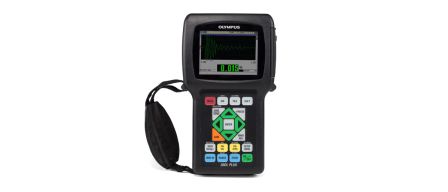
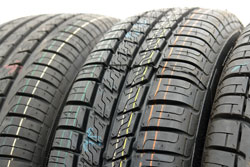
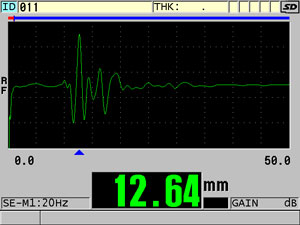
 AplicaciónMedición de la profundidad de cables de acero y de fibra o bandas en todo tipo de neumáticos de caucho y, en muchos casos, espesor total de la pared. ContextoPara fines de control de calidad, los fabricantes de neumáticos requieren conocer la posición de los cables de acero o fibra que se encuentran insertados en las paredes de los neumáticos de automóviles, camiones y vehículos todoterreno. Esto es especialmente importante en el caso de inspeccionar neumáticos costosos y de gran dimensión destinados a la maquinaria de construcción, en los cuales la ubicación incorrecta de dichos cables/hilos puede generar fallas costosas. En algunos casos, los fabricantes también desean medir el espesor total de pared del material. Esto requiere una atención particular, ya que el caucho es de elevada atenuación para ondas acústicas de alta frecuencia, y la estructura interna de la mayoría de los neumáticos genera un complejo patrón de ecos. EquipamientoExisten dos enfoques para medir neumáticos, dependiendo del espesor que deba ser medido. Olympus recomienda los siguientes equipos para aplicaciones específicas: Procedimiento de usoLa atenuación acústica y la estructura interna varían grandemente entre los varios tipos de neumáticos; por lo tanto, es importante evaluar cada aplicación individualmente. La medición de neumáticos siempre requiere sondas de baja frecuencia igual o inferior a 2,25 MHz. En algunos casos, es útil usar una sonda con una superficie antidesgaste de epoxi para optimizar el acoplamiento acústico entre la sonda y el caucho. La sonda que se recomienda mayormente para ensayos en neumáticos es la M1036 (de 2,25 MHz, 12,5 mm [0,5 pulg.] de diámetro con alta penetración) y la V601-RB (de 500 kHz, 25 mm [1 pulg.] de diámetro). En aplicaciones que involucran neumáticos de gran espesor (superior a 4 pulg. o 100 mm de caucho), se ha utilizado pares de sondas V601-RB en el modo de emisión y recepción [pitch-catch] con un detector de defectos. La separación de las funciones de emisión y recepción permite usar una ganancia de recepción muy alta sin experimentar los problemas potenciales de sonido asociados al aumento de la recuperación del impulso de excitación. Se recomienda el uso de un gel acoplante para todas las aplicaciones de neumáticos. Para asegurar un estado correcto de humedad, el acoplante debe actuar en la superficie del material. Tal como se efectúa en otras mediciones de espesor por ultrasonido, es necesario calibrar la velocidad acústica del caucho mediante una pieza de referencia de espesor conocido. La velocidad acústica del caucho varía rápidamente con la temperatura; por consiguiente, dicha velocidad debe medirse en función de una temperatura equiparable a la de las condiciones actuales de medición. La obtención de una medida satisfactoria de todo el espesor del neumático, a diferencia de la profundidad de los cables, depende de la estructura de dichos cables. En algunos tipos de neumáticos que presentan muchas capas de cables o en donde dichos cables son colocados estrechamente, la medición del espesor total será improbable debido a la poca energía acústica que llega a recibir la pared interna del material. En otros neumáticos que presentan una separación individual más amplia entre los cables, la energía acústica penetrará la pared interna y será posible medir el espesor total. Estas características deben ser evaluadas caso por caso. Por ejemplo, cuando un eco de la pared interna es visible, el equipo puede cambiar a una segunda configuración disponible para realizar la medición. La Figura 1 muestra el eco de los cables de acero que se mide a partir de la banda de rodamiento externa en neumático de automóvil, cuya banda de rodamiento presenta 12,5 mm de espesor aproximadamente. La medida es obtenida mediante el medidor de espesor 38DL PLUS y la sonda M1036 (2,25 MHz). En este caso, el eco se mide para el primer lóbulo positivo.
Figura 1
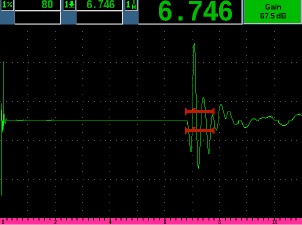
Figura 2 |


Medición de espesores en neumáticos

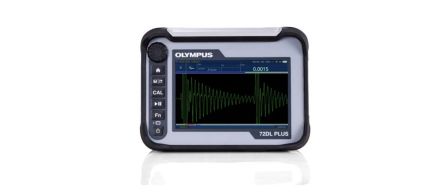
El medidor de espesores ultrasónico 72DL PLUS™ ofrece mediciones de espesor precisas y avanzadas a alta velocidad en un dispositivo portátil y fácil de usar. Compatible con sondas monoelemento de hasta 125 MHz, esta innovadora herramienta de medición de espesores es idónea para determinar el espesor de materiales ultrafinos, como la pintura, los revestimientos y el plástico de múltiples capas. Puede mostrar de forma simultánea el espesor de hasta seis capas.
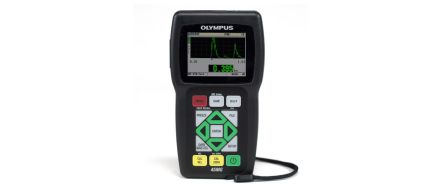
El 45MG es un avanzado medidor de espesores ultrasónico que cuenta con funciones de medición de serie y opciones de software. Está exclusiva herramienta de medición de espesores es compatible con nuestro rango completo de sondas duales y monoelementos dedicadas a medir espesores.