Inspection & Measurement Systems

Applications

Application Notes

High Temperature Ultrasonic Testing
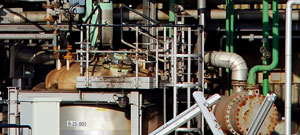
Background: Although most ultrasonic flaw detection and thickness gaging is performed at normal environmental temperatures, there are many situations where it is necessary to test a material that is hot. This most commonly happens in process industries, where hot metal pipes or tanks must be tested without shutting them down for cooling, but also includes manufacturing situations involving hot materials, such as extruded plastic pipe or thermally molded plastic immediately after fabrication, or testing of metal ingots or castings before they have fully cooled. Conventional ultrasonic transducers will tolerate temperatures up to approximately 50° C or 125° F. At higher temperatures, they will eventually suffer permanent damage due to internal disbonding caused by thermal expansion. If the material being tested is hotter than approximately 50° C or 125° F, then high temperature transducers and special test techniques should be employed.

This application note contains quick reference information regarding selection of high temperature transducers and couplants, and important factors regarding their use. It covers conventional ultrasonic testing of materials at temperatures up to approximately 500° C or 1000° F. In research applications involving temperatures higher than that, highly specialized waveguide techniques are used. They fall outside the scope of this note.

1. Transducers
Panametrics-NDT high temperature transducers fall into two categories, dual element transducers and delay line transducers. In both cases, the delay line material (which is internal in the case of duals) serves as thermal insulation between the active transducer element and the hot test surface. For design reasons, there are no high temperature contact or immersion transducers in the standard product line. High temperature duals and delay line transducers are available for both thickness gaging and flaw detection applications. As with all ultrasonic tests, the best transducer for a given application will be determined by specific test requirements, including the material, the thickness range, the temperature, and in the case of flaw detection, the type and size of the relevant flaws.

(a) Thickness gaging
The most common application for high temperature thickness gaging is corrosion survey work, the measurement of remaining metal thickness of hot pipes and tanks with corrosion gages such as Models 38DL PLUS and the MG2 series. Most of the transducers that are designed for use with Panametrics-NDT corrosion gages are suitable for high temperature use. The commonly used D790 series transducers can be used on surfaces as hot as 500° C or 930° F. For a complete list of Panametrics-NDT corrosion gaging duals that includes temperature specifications, see this link: Corrosion Gage Duals.

For precision thickness gaging applications with Model 35 Series such as hot plastics, any of the standard Microscan delay line transducers in the M200 series (including gage default transducers M202, M206, M207, and M208) can be equipped with high temperature delay lines. DLHT-1, -2, and -3 delay lines may be used on surfaces up to 260° C or 500° F. DLHT-101, -201, and -301 delay lines may be used on surfaces up to 175° C or 350° F. These delay lines are listed in the Delay Line Option Chart.

In challenging applications requiring low frequency transducers for increased penetration, the Videoscan Replaceable Face Transducers and appropriate high temperature delay lines can also be used the Model 25-series thickness gages. Standard delay lines for this family of transducers can be used in contact with surfaces as hot as 480° C or 900° F. For a full list of transducers and delay lines, see this link: Replaceable Face Transducers.

(b) Flaw detection
As in high temperature thickness gaging applications, high temperature flaw detection most commonly uses dual element or delay line transducers. All standard Panametrics-NDT flaw detection duals offer high temperature capability. Fingertip, Flush Case, and Extended Range duals whose frequency is 5 MHz or below may be used up to approximately 425° C or 800° F, and higher frequency duals (7.5 and 10 MHz) may be used up to approximately 175° C or 350° F. For a full list of transducers in this category, see this link: Flaw Detection Duals.

All of the Videoscan Replaceable Face Transducers can be used with appropriate high temperature delay lines in flaw detection applications. The available delay lines for this family of transducers can be used in contact with surfaces as hot as 480° C or 900° F. For a full list of transducers and delay lines suitable for various maximum temperatures, see this link: Replaceable Face Transducers.

Applications involving thin materials are often best handled by the delay line transducers in the V200 series (most commonly the V202, V206, V207, and V208), any of which can be equipped with high temperature delay lines. DLHT-1, -2, and -3 delay lines may be used on surfaces up to 260° C or 500° F. DLHT-101, -201, and -301 delay lines may be used on surfaces up to 175° C or 350° F. These transducers and delay lines are listed on the Delay Line Transducer List.

We also offers special high temperature wedges for use with angle beam transducers, the ABWHT series for use up to 260° C or 500° F and the ABWVHT series for use up to 480° C or 900° F. Detailed information on available sizes is available from the Sales Department.

2. Couplants
Most common ultrasonic couplants such as propylene glycol, glycerin, and ultrasonic gels will quickly vaporize if used on surfaces hotter than approximately 100° C or 200° F. Thus, ultrasonic testing at high temperatures requires specially formulated couplants that will remain in a stable liquid or paste form without boiling off, burning, or releasing toxic fumes. It is important to be aware of the specified temperature range for their use, and use them only within that range. Poor acoustic performance and/or safety hazards may result from using high temperature couplants beyond their intended range.

At very high temperatures, even specialized high temperature couplants must be used quickly since they will tend to dry out or solidify and no longer transmit ultrasonic energy. Dried couplant residue should be removed from the test surface and the transducer before the next measurement.

Note that normal incidence shear wave coupling is generally not possible at elevated temperatures because commercial shear wave couplants will liquify and loose the very high viscosity that is necessary for transmission of shear waves.

We offer two types of high temperature couplant:

Couplant E - Ultratherm Recommended for use between 500° and 970° F (260° to 520° C)

Couplant G - Medium Temperature Couplant Recommended for use at temperatures up to 600° F (315° C).
For a complete list of couplants available from Panametrics-NDT, along with further notes on each, please refer to NDT Application note on Ultrasonic Couplants.

3. Test Techniques
The following factors should always be taken into consideration in establishing a test procedure for any high temperature application:
Duty Cycle: All standard high temperature transducers are designed with a duty cycle in mind. Although the delay line insulates the interior of the transducer, lengthy contact with very hot surfaces will cause significant heat buildup, and eventually permanent damage to the transducer if the interior temperature becomes hot enough. For most dual element and delay line transducers, the recommended duty cycle for surface temperatures between approximately 90° C and 425° C (200° F to 800° F) is no more than ten seconds of contact with the hot surface (five seconds is recomended), followed by a minimum of one minute of air cooling. Note that this is guideline only; the ratio of contact time to cooling time becomes more critical at the upper end of a given transducer's specified temperature range. As a general rule, if the outer case of the transducer becomes too hot to comfortably hold with bare fingers, then the interior temperature of the transducer is reaching a potentially damaging temperature and the transducer must be allowed to cool down before testing continues. Some users have employed water cooling to accelerate the cooling process, however Panametrics-NDT publishes no official guidelines for water cooling and its appropriateness must be determined by the individual user.

The Panametrics-NDT Epoch series flaw detectors, and 38DL PLUS and MG2 thickness gages, all have freeze functions that can be used to freeze the displayed waveform and reading. The freeze function is very useful in high temperature measurements because it allows the operator to capture a reading and quickly remove the transducer from the hot surface.

With gages, the fast screen update mode should be used to help minimize contact time.

Coupling Technique: The combination of transducer duty cycle requirements and the tendency of couplants to solidify or boil off at the upper end of their usable thickness range requires quick work on the part of the operator. Many users have found the best technique to be to apply a drop of couplant to the face of the transducer and then press the transducer firmly to the test surface, without twisting or grinding it (which can cause transducer wear). Any dried couplant residue should be removed from the transducer tip between measurements.

Gain Boost: Both the 38DL and MG2 gages have gain boost functions, as do all Epoch flaw detectors. Because of the higher attenuation levels associated with high temperature measurements, it is often useful to increase gain before making measurements.

Velocity Variation: Sound velocity in all materials changes with temperature, slowing down as the material heats up. Accurate thickness gaging of hot materials always requires velocity recalibration. In steel, this velocity change is approximately 1% per 55° C or 100° F change in temperature. (The exact value varies depending on the alloy.) In plastics and other polymers, this change is much greater, and can approach 50% per 55° C or 100° F change in temperature up to the melting point. If a temperature/velocity plot for the material is not available, then a velocity calibration should be performed on a sample of the test material at the actual test temperature.

Zero Recalibration: When performing thickness gaging with dual element transducers, remember that the zero offset value for a given transducer will change as it heats up due to changes in transit time through the delay line. Thus, periodic re-zeroing is necessary to maintain measurement accuracy. With Panametrics-NDT corrosion gages (Models 38DL PLUS and MG2), this can be quickly and easily done through the gage's auto-zero function; simply press the ZERO key.

Increased Attenuation: Sound attenuation in all materials increases with temperature, and the effect is much more pronounced in plastics than in metals or ceramics. In typical fine grain carbon steel alloys, attenuation at 5 MHz at room temperature is approximately 2 dB per 100 mm one-way sound path (equivalent to a round trip path of 50 mm each way). At 500° C or 930° C, attenuation increases to approximately 15 dB per 100 mm of sound path. This effect can require use of significantly increased instrument gain when testing over long sound paths at high temperature, and can also require adjustment to distance/amplitude correction (DAC) curves or TVG (Time Varied Gain) programs that were established at room temperature. Temperature/attenuation effects in polymers are highly material dependent, but will be typically be several times greater than the above numbers for steel. In particular, long high temperature delay lines that have heated up may represent a significant source of total attenuation in a test.

Angular Variation in Wedges: With any high temperature wedge, sound velocity in the wedge material will decrease as it heats up, and thus the refracted angle in metals will increase as the wedge heats up. If this is of concern in a given test, refracted angle should be verified at actual operating temperature. As a practical matter, thermal variations during testing will often make precise determination of the actual refracted angle difficult.

Products used for this application

26MG

The pocket-sized 26MG ultrasonic thickness gage uses dual element transducers for corrosion applications. Weighs only 8.5 oz. (0.24 kg) and offers basic features such as Automatic Probe Recognition, Fast Min mode, and long battery life.

35

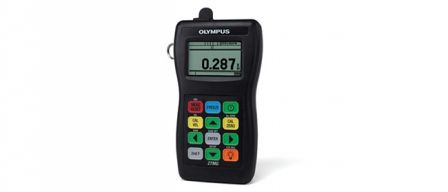
The pocket-sized 35 is a handheld ultrasonic thickness gage for precision measurements on metal, plastic, rubber, glass, and composites using single element transducers. Wide thickness range from 0.08 mm to 635.0 mm (0.0030 in. to 25.0 in.) Optional live Waveform and Adjust Mode.

38DL PLUS

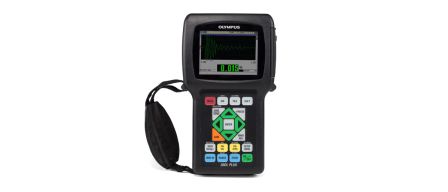
The 38DL PLUS is an advanced ultrasonic thickness gage. Uses dual element transducer for internally corroded applications, features include THRU-COAT and Echo-to-Echo. Uses single element transducers for very precise thickness measurements of thin, very thick, or multilayer materials.

EPOCH 600NEW

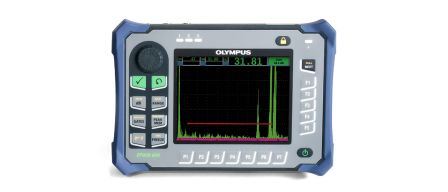
The EPOCH 600 is mid-level, handheld ultrasonic flaw detector. Weighing only 1.68 kg (3.72 lb.), its horizontal case is built to withstand the rigors of very harsh environments. EN12668-1 plus features such as 400 V PerfectSquare tunable square wave pulser, digital filtering for enhanced signal-to-noise ratio.

EPOCH LT

The EPOCH LT is a basic, handheld digital flaw detector, 38 mm (1.5 in.) thick and packed in a 1 kg (2.35 lbs) vertical package gives fast display update rate at a minimum 60 Hz, automated transducer calibration, a numeric datalogger, and many other measurement features.

EPOCH LTC

The EPOCH LTC is a mid-level, handheld ultrasonic flaw detector in a compact 2.12 lbs (0.96 kg) vertical case. It is a full-featured instrument with EN12668-1 compliance and a wide variety of standard features as well as specialized options to meet your inspection needs.

EPOCH XT

The EPOCH XT is an advanced, portable ultrasonic flaw detector offering many standard measurement features including a tunable square wave pulser, selectable narrow-band and broad-band digital filters, gain range from 0 to 110 dB, peak memory and peak hold, and adjustable PRF.

MG2

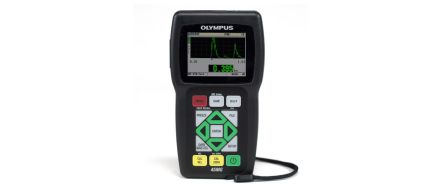
The handheld MG2 ultrasonic thickness gage uses dual element transducers for corrosion applications. It offers many basic features such as Min/Max Mode that measures and recalls the minimum thickness at a fast 20 readings per second, Freeze Mode to instantly capture critical thickness, and Zero Compensation.

English | 日本語 | français | 简体中文 | Deutsch | italiano | čeština | magyar | Tiểng Việt | Español | русский | polski | português | 한국어